How Long to Warm Up Your Car in Winter (Gas, Diesel, Hybrid and EV)
It is 7 a.m., the windshield is white, and the thermometer says 18°F. Your first instinct is to warm up your car the old way: start the engine, run back inside, and come out to a toasty cabin fifteen minutes later. Most of us learned that habit from a parent who drove a carbureted sedan in the 1980s.
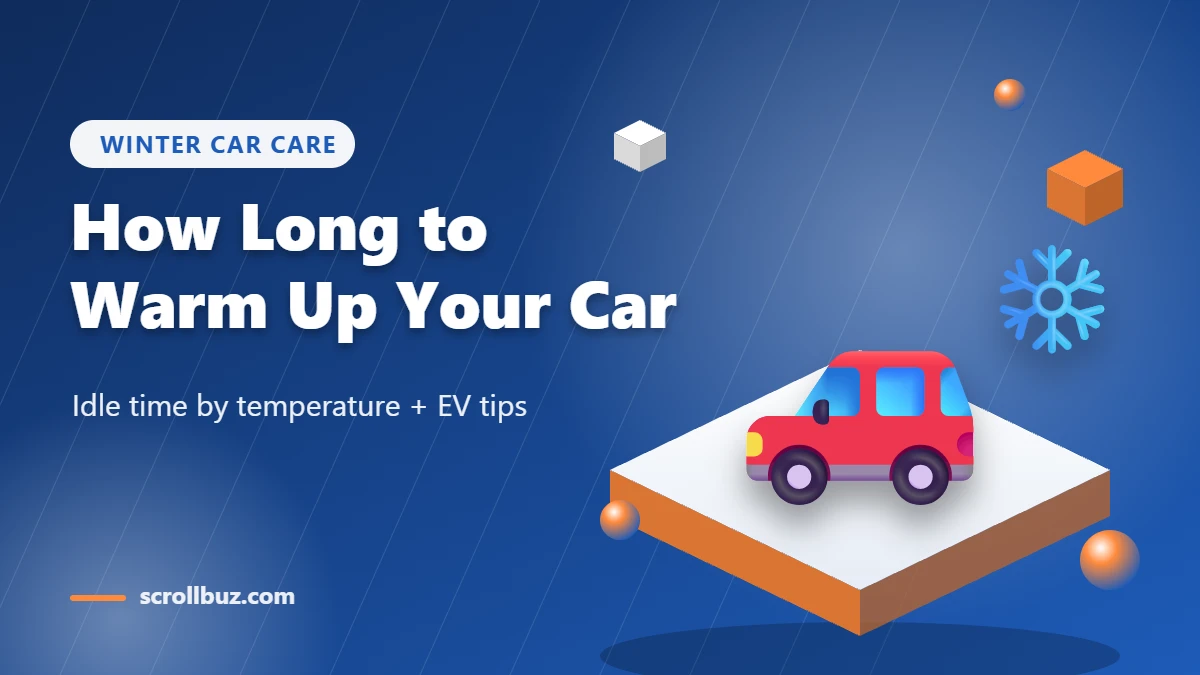
Here is the short answer: a modern car needs about 30 seconds to 2 minutes of idling before you drive gently. That is it. Below we cover exactly how long to warm up your car at different temperatures, what changes for diesels, hybrids and EVs, and the safety and legal points most guides skip.
Quick answer
- Above 32°F (0°C): 30 seconds, then drive gently.
- 0°F to 32°F (-18°C to 0°C): 1 to 2 minutes, then drive gently for 5 to 10 minutes.
- Below 0°F (-18°C): 2 to 5 minutes, ideally with a block heater plugged in overnight.
- Diesel: wait for the glow plug light, then 3 to 5 minutes in hard cold.
- EV: no idling at all. Precondition while plugged in.

Do You Really Need to Warm Up Your Car?
Yes, but far less than you think. The long idle made sense when cars used carburetors. A cold carburetor could not mix fuel and air properly, so the engine stalled or stumbled until it warmed through.
Almost every car sold in the US since the early 1990s uses electronic fuel injection. Sensors read the air and coolant temperature and adjust the fuel mix in real time. The engine is ready to move in under a minute, even on a frosty morning.
What still needs warmth is everything else: the oil, the transmission fluid, the tires, the shocks and the wheel bearings. Idling barely warms those. Driving does. That is why the best way to warm up your car is to drive it, gently, after a short idle.
How Long to Warm Up Your Car by Temperature
Use this table as a practical guide. These times to warm up your car assume a healthy battery and the right winter oil.
| Outside temperature | Idle time | Then |
|---|---|---|
| Above 40°F (4°C) | 0 to 30 seconds | Drive normally after a minute or two |
| 32°F to 40°F (0°C to 4°C) | 30 seconds | Light throttle for the first 5 minutes |
| 10°F to 32°F (-12°C to 0°C) | 1 to 2 minutes | Under 3,000 rpm for 5 to 10 minutes |
| -10°F to 10°F (-23°C to -12°C) | 2 to 3 minutes | Gentle driving for 10 to 15 minutes |
| Below -10°F (-23°C) | 3 to 5 minutes | Use a block heater; avoid hard acceleration |
The idle time is mostly about letting oil pressure build and giving you time to clear the glass. If you can see clearly and the engine settles to a steady idle, you are ready.
Why Idling for 10+ Minutes Is a Bad Idea
Idling for ten minutes to warm up your car feels kind to the engine, but it works against it in a few ways.
1. Fuel washes oil off the cylinder walls
A cold engine runs rich, meaning it sprays extra fuel. Some of that fuel does not burn. It can strip oil from the cylinder walls and drip into the crankcase, thinning your oil over time. This is called fuel dilution, and long cold idles make it worse.
2. The engine warms slowly at idle
An idling engine produces very little heat. It can take 10 minutes or more to reach operating temperature parked, while gentle driving gets you there in about half the time.
3. It burns money
The US Department of Energy estimates idling uses roughly a quarter to a half gallon of fuel per hour, depending on engine size. Ten minutes a day across a winter adds up to a full tank or more. If saving fuel matters, our guide on how to save money on gas has more easy wins.
4. Your catalytic converter stays cold
The converter cleans exhaust only once it is hot. Long idles keep it cool, which means more pollution and, over years, more carbon build-up.
The Right Way to Warm Up Your Car (Step by Step)
- Clear the tailpipe. After snowfall, make sure the exhaust is not blocked. A buried tailpipe can push carbon monoxide into the cabin.
- Start the engine with accessories off. Turn off the heater fan, rear defrost and radio so the battery puts all its power into cranking.
- Let it idle 30 seconds to 2 minutes. Use this time to brush snow off the roof, lights and mirrors.
- Turn on the defroster. Set it to fresh air (not recirculate) with A/C on to dry the air. Our guide on how to defrost car windows fast covers the best settings.
- Drive gently. Keep revs low, avoid hard launches and skip the highway on-ramp sprint for the first 5 to 10 minutes.
- Watch the temperature gauge. Once it reaches its normal middle position, drive as usual.
Follow these steps and you warm up your car faster, safer and cheaper than a long idle ever could.
Diesel, Hybrid, Turbo and EV: What Changes
Most articles stop at gas engines. Here is what to know if you drive something different.
Diesel trucks and SUVs
Diesels rely on compression heat to ignite fuel, so cold weather hits them harder. Always wait for the glow plug light to go out before cranking. In single digits, plan to warm up your car for 3 to 5 minutes. Below about 15°F, a block heater is the single best upgrade you can make. Use winter-blend diesel or an anti-gel additive to stop fuel from clouding.
Turbocharged engines
Turbos spin very fast and depend on warm oil. When you warm up your car with a turbo engine, the idle time is the same as any modern gas engine, but avoid boost (hard acceleration) until the engine is warm. That protects the turbo bearings.
Hybrids
With a hybrid, there is no need to sit and warm up your car. When it is cold, the gas engine often starts by itself to warm the catalytic converter and cabin. That is normal. Just get in, clear the glass and drive. Our hybrid car maintenance guide explains more about how these systems behave.
Electric vehicles
With an EV, you never need to warm up your car in the old driveway sense. There is no engine to warm, but cold batteries lose range and charge slowly. The smart move is to precondition through your car’s app while it is still plugged in. The car heats the battery and cabin using grid power instead of your range. Set a departure time the night before and it happens automatically.
Remote Starters: Handy, With a Few Rules
A remote starter is a great way to warm up your car while you stay inside, as long as you keep the run time short. Set it for 5 minutes or less, not 15. A few things to check:
- Never in a closed garage. Even with the door cracked, carbon monoxide builds up fast and can seep into your home.
- Local idling laws. Many US states and cities limit idling time, often to 3 to 5 minutes. Some areas ban leaving an unattended running vehicle entirely. Check your city or state rules before you rely on a long remote start.
- Theft risk. A running car with keys inside is an easy target, a practice police call “puffing.” Factory remote starters keep doors locked and shut off if someone tries to drive without the key, which is safer than leaving the key in.
- Insurance. Some policies may reduce or deny a theft claim if the keys were left in a running car. Read yours.
Signs Your Car Needs More Than a Warm-Up
Sometimes the problem is not how long you warm up your car at all. Pay attention if you notice:
- Slow, groaning crank or a clicking sound: often a weak battery. Cold cuts battery power sharply. See our guide on a clicking noise when trying to start the car.
- Battery warning light: could be the alternator or a loose belt. Read battery light on in car for the causes.
- Rough idle that does not smooth out after 2 minutes: possible ignition, sensor or vacuum leak issue.
- Heater blows cold after 15 minutes of driving: low coolant or a stuck-open thermostat.
- Loud ticking that fades: often thick oil. Check your owner’s manual for the right winter viscosity, such as 0W-20 or 5W-30, and check your oil level regularly.

Cold-Weather Habits That Make Warm-Up Easier
A little prep the night before makes it easier to warm up your car quickly every morning.
- Park in a garage or out of the wind. Even a carport helps the engine stay a few degrees warmer.
- Use a block heater below 0°F. Plug it in 2 to 4 hours before you leave, using a timer outlet to save power.
- Keep the tank at least half full. Less air in the tank means less moisture and less risk of frozen fuel lines.
- Test your battery each fall. Most auto parts stores do it for free.
- Pack a kit. Our winter car emergency kit checklist lists the 25 essentials to keep on board.
Frequently Asked Questions
How long should you warm up your car in the morning?
For most modern cars, 30 seconds to 2 minutes is enough. In extreme cold below 0°F, allow 3 to 5 minutes and use a block heater if you have one.
Is it bad to drive right after starting a cold car?
No, as long as you drive gently. Avoid high revs and hard acceleration until the temperature gauge rises. Gentle driving warms the whole drivetrain faster than idling.
Should you warm up your car if it is brand new?
Yes, the same short idle applies. Many new cars also have break-in rules for the first 500 to 1,000 miles, so check the manual.
Does idling drain the battery?
Idling with the heater, seat heaters and lights on can drain a weak battery over time, because the alternator puts out little power at low rpm. A short drive charges it far better.
Can you warm up your car in the garage with the door open?
It is not recommended. Carbon monoxide can build up quickly and enter the house. Back the car out first, then let it idle outside.
The Bottom Line
A quick idle and a gentle drive is the modern way to warm up your car. You save fuel, protect your oil and engine, and get heat in the cabin sooner. Save the longer warm-up for truly brutal mornings, diesels and cars without a block heater, and let your EV handle it with preconditioning. Stay safe out there this winter.