


Some card games take an hour to learn. Screw Your Neighbor takes about two minutes, and that’s exactly why it’s a favorite at family gatherings, college dorms, and holiday parties. Every player gets one card, makes one choice, and tries not to end up holding the lowest card at the table.
It’s simple, fast, and full of small moments of betrayal, which is where the name comes from. In this guide you’ll learn the full Screw Your Neighbor card game rules, how the King block works, a few strategy tips that actually help, and popular variations to keep the game fresh.
Quick overview: Each player is dealt one card face down and starts with three lives. Going around the table, each player either keeps their card or swaps it with the player on their left. The dealer goes last and can swap with the deck. Everyone reveals, and the lowest card loses a life. The last player with lives left wins.
Screw Your Neighbor at a Glance
| Detail | Info |
|---|---|
| Players | 3 to 15 (best with 5 to 10) |
| Deck | One standard 52-card deck, no jokers |
| Ages | 7 and up |
| Game length | 15 to 30 minutes |
| Goal | Avoid having the lowest card and be the last player with lives |
| Also known as | Cuckoo, Ranter-Go-Round, and a close cousin of Chase the Ace |

What You Need to Play
- A standard 52-card deck
- Three tokens per player to track lives, such as coins, poker chips, candies, or matchsticks
- A table where everyone can reach their neighbors
Many groups play with a small pot: each player puts in three coins, loses one to the middle each time they lose a round, and the winner takes the pot. Playing for candy works just as well and keeps it family-friendly.
Card Rankings
In Screw Your Neighbor, suits don’t matter. Only the rank counts:
- Aces are low (the worst card to hold)
- Then 2, 3, 4, 5, 6, 7, 8, 9, 10, Jack, Queen
- Kings are high (the best card, with a special power)
How to Set Up the Game
- Choose a dealer. Many groups have everyone draw a card, and the highest card deals first.
- Give each player three lives.
- The dealer shuffles and deals one card face down to each player, including themselves.
- Players look at their own card without showing anyone.
- Place the rest of the deck face down in front of the dealer.
Screw Your Neighbor Card Game Rules: Step by Step
1. The Player Left of the Dealer Goes First
Play moves clockwise. On your turn, you have exactly two choices:
- Keep your card (often called “stick” or “stay”), or
- Swap your card with the player on your left by saying “trade” or “screw you.”
If someone trades with you, you have to accept, unless you’re holding a King.
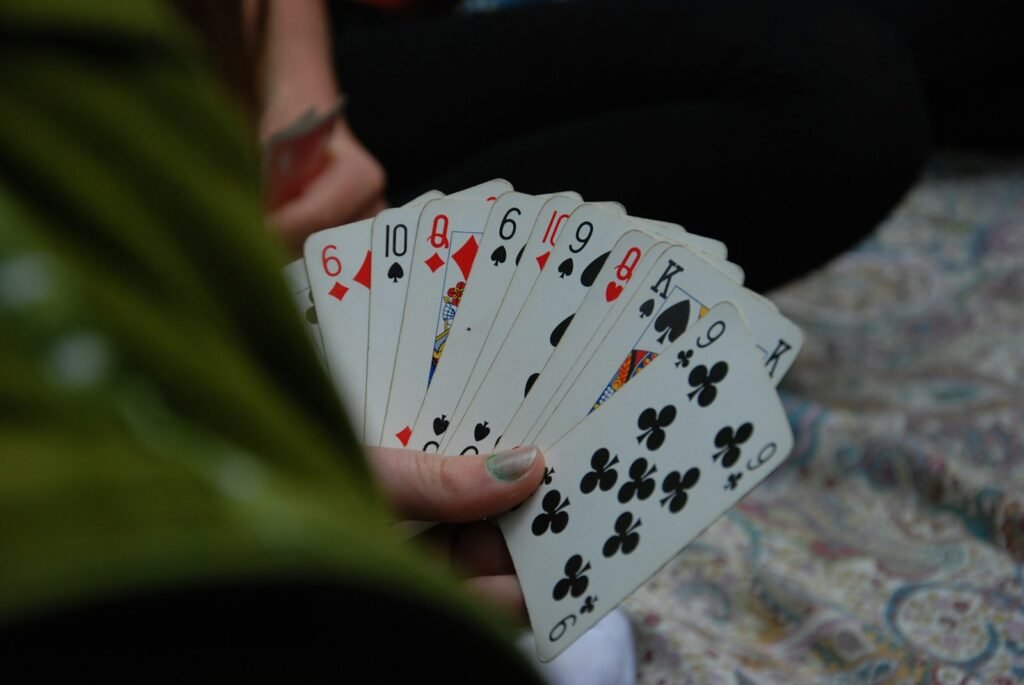
2. The King Block
Kings are protected. If someone tries to trade with you while you’re holding a King, you immediately flip it face up and say “King.” The trade is blocked. The player who tried to trade is stuck with their own card, and play moves on. Since your King is revealed, everyone now knows you’re safe this round.
3. Getting a Card Passed to You
If you receive a new card through a trade, you now have that card when your turn comes. You can keep it or trade it to your left. This is where things get interesting: a low card can travel several seats around the table before someone finally gets stuck with it.
4. The Dealer’s Turn
The dealer goes last. Instead of trading with a player, the dealer can either keep their card or cut the deck and take the top card as a replacement. Once the dealer draws, they must keep the new card, even if it’s worse.
5. Reveal and Lose a Life
Everyone flips their card face up. The player with the lowest card loses one life. If two or more players tie for lowest, all of them lose a life.
6. Pass the Deal and Repeat
The deal moves one seat to the left. Rounds continue until players run out of lives. When you lose your third life, you’re out. The last player standing wins.

A Quick Example Round
Imagine four players: Sam, Priya, Leo, and Maya (the dealer).
- Sam has a 3 and trades with Priya, who had a 9. Now Sam holds the 9 and Priya holds the 3.
- Priya trades the 3 to Leo, but Leo has a King. He flips it, and the trade is blocked. Priya keeps the 3.
- Leo keeps his King.
- Maya, the dealer, has a 6. She decides to keep it rather than risk the deck.
Everyone reveals. Priya has the lowest card, the 3, so she loses a life.
Strategy Tips to Win More Rounds
Screw Your Neighbor is mostly luck, but smart choices make a difference over a long game.
- Know when to stick. A 7 or higher is usually worth keeping in small groups. With more players, you may want to keep cards as low as 5 or 6, since there are more cards to beat.
- Always trade an Ace or 2. There’s almost no way to end up worse.
- Watch what comes to you. If your neighbor traded you a card, you know they didn’t like it. If you got a 4, the player before them might have kept something better.
- Remember revealed Kings. Never try to trade with someone who has already shown a King this round.
- Dealers should play the odds. If you hold a 4 or lower, drawing from the deck is usually a good bet.

Popular Variations
Aces High
Some families play with Aces as the highest card instead of the lowest. Decide before the game so there are no arguments.
Dealer Deck Penalty
In some versions, if the dealer draws a King from the deck, they automatically lose a life. It adds a bit of extra risk to the dealer’s choice.
The Pot Game
Each player starts with three coins. Every time you lose a round, you put a coin in the pot. The last player standing takes everything.
One-Round Elimination
For large groups, play with one life each. It’s quick and works well as an icebreaker or a tie-breaker at the end of game night.
Why People Love This Game
Screw Your Neighbor works for almost any group. Kids understand it right away, adults enjoy the light bluffing, and it scales to a big crowd better than most card games. If you’re building a game night lineup, it pairs nicely with quick games like the Golf card game and the fast-paced Speed card game. Playing with just one other person? Try our list of 2 player card games for couples.
Frequently Asked Questions
Can you refuse a trade in Screw Your Neighbor?
Only if you’re holding a King. Otherwise, you must accept any trade from the player on your right.
What happens if two players tie for the lowest card?
Under standard rules, every player tied for the lowest card loses a life.
How many players do you need?
You can play with as few as three, but the game is most fun with five to ten players. With more than ten, consider using two decks.
Is Screw Your Neighbor a drinking game?
Some adults play it that way, but it’s really a simple family card game. Playing with coins, candy, or chips works just as well.
Final Thoughts
Once you know the Screw Your Neighbor card game rules, you can teach them to a whole table in a couple of minutes. Grab a deck, hand out three tokens to everyone, and start dealing. Just don’t be surprised when your favorite cousin passes you an Ace with a big smile.