Pay Yourself First: What It Means and How to Start (With a Real Example)
Most people save whatever is left at the end of the month. The problem is that there’s rarely anything left. This method flips that order: you move money into savings the moment your paycheck lands, then you live on the rest.
It sounds simple because it is. But a few details decide whether it works for you or leaves you short on rent. This guide covers what pay yourself first means, how much to set aside, a real paycheck example, and how to make it automatic so you never have to think about it.
What Does Pay Yourself First Mean?
To pay yourself first means treating your savings like a bill that gets paid before anything else. Before groceries, before streaming services, before takeout, a set amount goes to your future self.
The idea became popular through personal finance classics, but the logic is about behavior, not math. When money sits in checking, it gets spent. When it’s moved out right away, you adjust your spending to what’s left, the same way you’d adjust if your rent went up.
“Yourself” can mean any of these goals:
- An emergency fund for surprise bills
- Retirement accounts like a 401(k) or IRA
- A sinking fund for planned costs like car repairs or Christmas
- Extra payments on high-interest debt
- A down payment or other big goal
Pay Yourself First vs Traditional Budgeting
A traditional budget tracks every category, then saves the leftovers. This approach sets the savings number first and gives you more freedom with the rest.
| Traditional budget | Pay yourself first | |
|---|---|---|
| When you save | End of the month | Payday |
| Tracking needed | Every category | Mostly just the savings amount |
| Main risk | Nothing left to save | Overdrafts if the amount is too high |
| Best for | Detail lovers | Busy people who hate tracking |
You can also combine them. The 50/30/20 budget rule gives you a target (20% for savings), and the pay yourself first habit makes sure that 20% actually happens. If you like full control, a zero-based budget works well with it too.
How Much Should You Pay Yourself First?
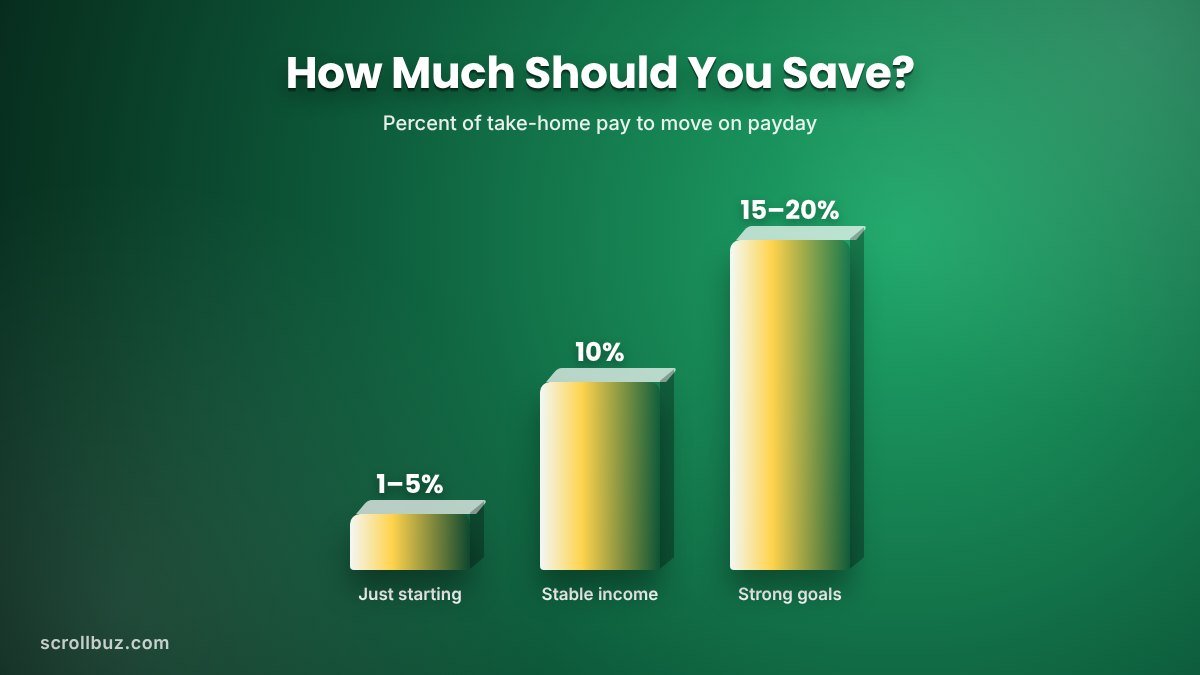
There’s no single right number. Use these as starting points:
- Just starting out or tight budget: 1% to 5% of take-home pay
- Stable income, some debt: 10%
- Strong goals or no debt: 15% to 20% or more
If 10% feels impossible, start with 1%. The habit matters more than the amount in the first few months. Raise it by 1% every time you get a raise or pay off a bill.
How to Pay Yourself First in 6 Steps
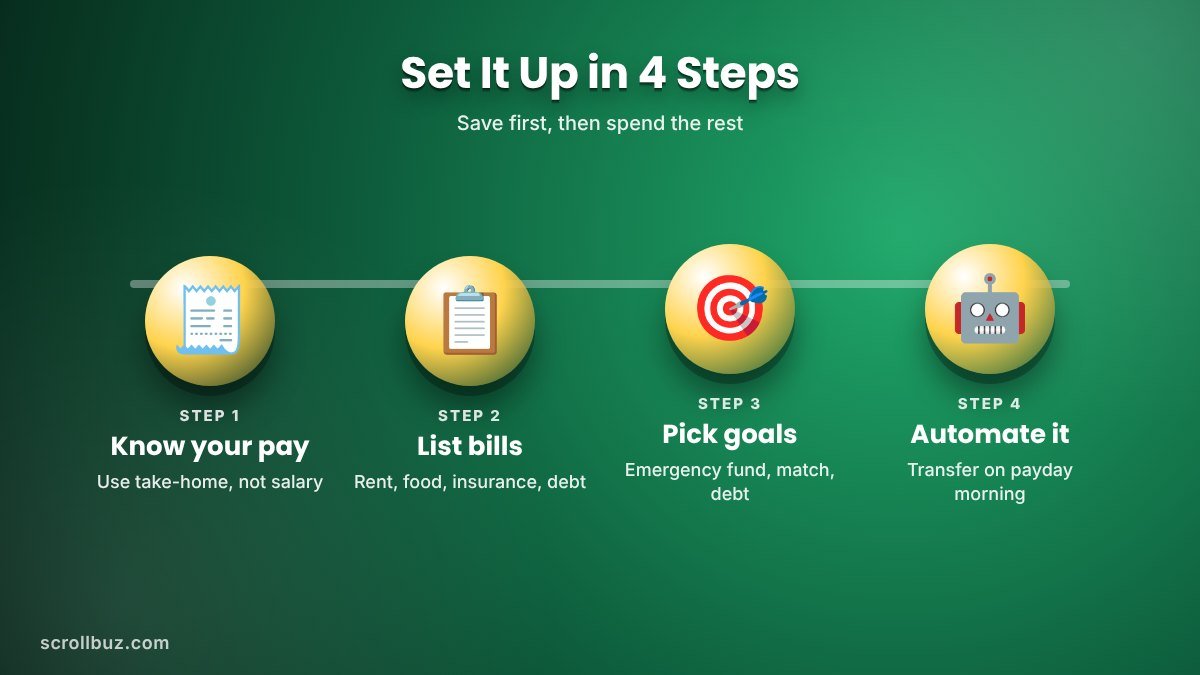
1. Know your take-home pay
Look at what actually hits your bank account, not your salary. If your income changes month to month, use your lowest month from the past year.
2. List your must-pay bills
Add up rent, utilities, insurance, minimum debt payments, groceries and transportation. This tells you how much room you really have.
3. Pick your savings goals in order
A smart order for most people:
- A starter emergency fund of $1,000
- Enough 401(k) contribution to get the full employer match
- Pay off high-interest credit cards
- Grow the emergency fund to 3 to 6 months of expenses
- Retirement and long-term goals
4. Choose a fixed amount or percentage
A percentage grows automatically with your income. A fixed amount is easier if your pay changes often.
5. Automate it
This is the step that makes the whole system work. Set up a split direct deposit through your employer, or schedule an automatic transfer for the morning of payday. Send it to a separate high-yield savings account at a different bank so it’s harder to dip into.
6. Live on the rest
Spend what’s left without guilt. Your savings are already done. If you run short, cut back a flexible category before touching savings.
A Real Paycheck Example
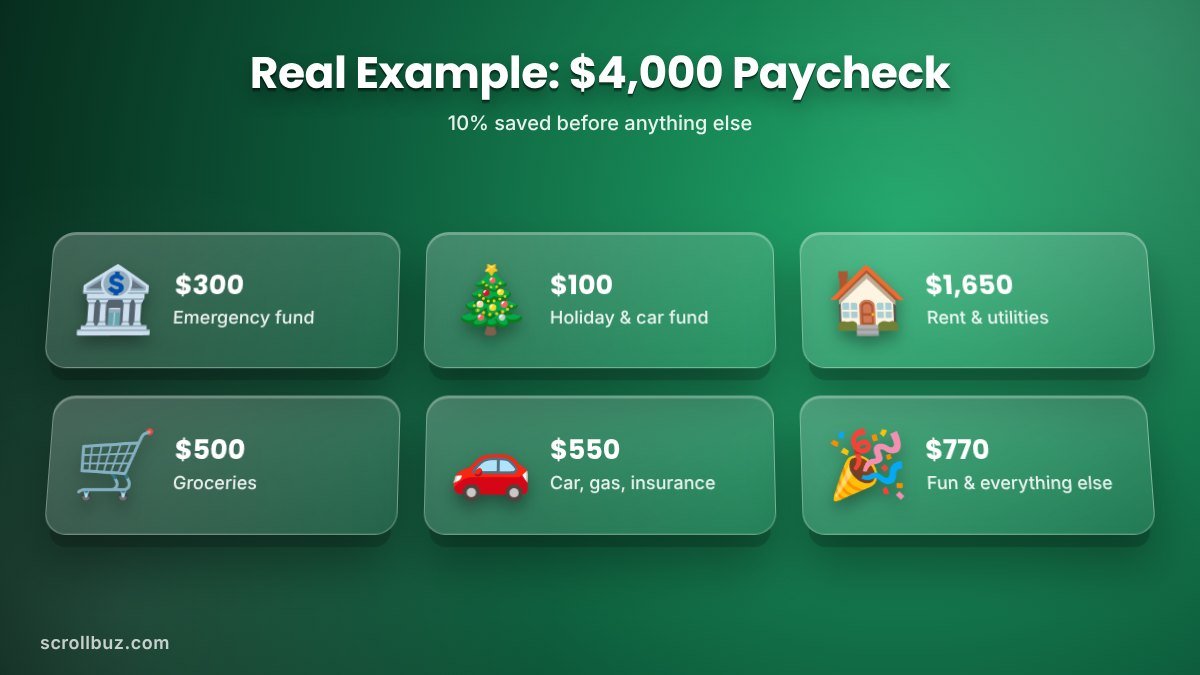
Meet Jordan, who takes home $4,000 a month. Here’s how Jordan sets it up:
| Item | Monthly amount |
|---|---|
| 401(k) (taken out before take-home pay) | 5% of salary, gets full match |
| Emergency fund transfer on payday | $300 |
| Holiday and car sinking fund | $100 |
| Total paid to self from take-home | $400 (10%) |
| Rent and utilities | $1,650 |
| Groceries | $500 |
| Car, gas and insurance | $550 |
| Phone and internet | $130 |
| Fun, eating out and everything else | $770 |
After one year, Jordan has $3,600 in emergency savings and $1,200 for holidays and car repairs, without tracking every coffee. When Jordan got a 3% raise, the payday transfer went up to $420.
Pros and Cons of Paying Yourself First
Pros
- Savings happen automatically, every time
- Less tracking and fewer money decisions
- Builds a cushion that protects you from debt
- Works on almost any income
Cons
- Can cause overdrafts if you save too much too soon
- Doesn’t help with overspending in other areas by itself
- Hard to start when you’re living paycheck to paycheck
How to Pay Yourself First on a Low Income
If money is tight, the habit can still work. You just start smaller.
- Start with $10 or $20 per paycheck.
- Save “found money” like tax refunds, rebates and cash gifts.
- Try a no-spend challenge for a week and move what you saved.
- Use a cash envelope system for groceries and fun money so the rest of your budget stays on track.
- Round up purchases with an app that moves spare change to savings.
Even $20 a paycheck adds up to $520 a year. That’s enough to cover a flat tire or a car battery without reaching for a credit card.
What to Do With Irregular Income
Freelancers, gig workers and people paid on commission can still save first. The trick is to base everything on your lowest month, not your average one.
- Open a “holding” account where all income lands.
- Pay yourself a steady “salary” from it each month, based on your lowest month.
- Move a fixed percentage of every deposit, such as 15%, into savings the day it arrives.
- In big months, leave the extra in the holding account to cover slow months.
- Set aside money for taxes too, often 25% to 30% for self-employed workers, in its own account.
This smooths out the ups and downs, so a slow month doesn’t force you to raid your savings.
How to Stay Motivated
Saving on autopilot is easy to set up and easy to forget. A few small things keep you going:
- Give each savings account a name, like “Car fund” or “Hawaii 2027.”
- Check your balances once a month, not every day.
- Celebrate milestones, like your first $500 or $1,000.
- Increase the transfer each time a debt is paid off, so the money keeps working.
Common Mistakes to Avoid
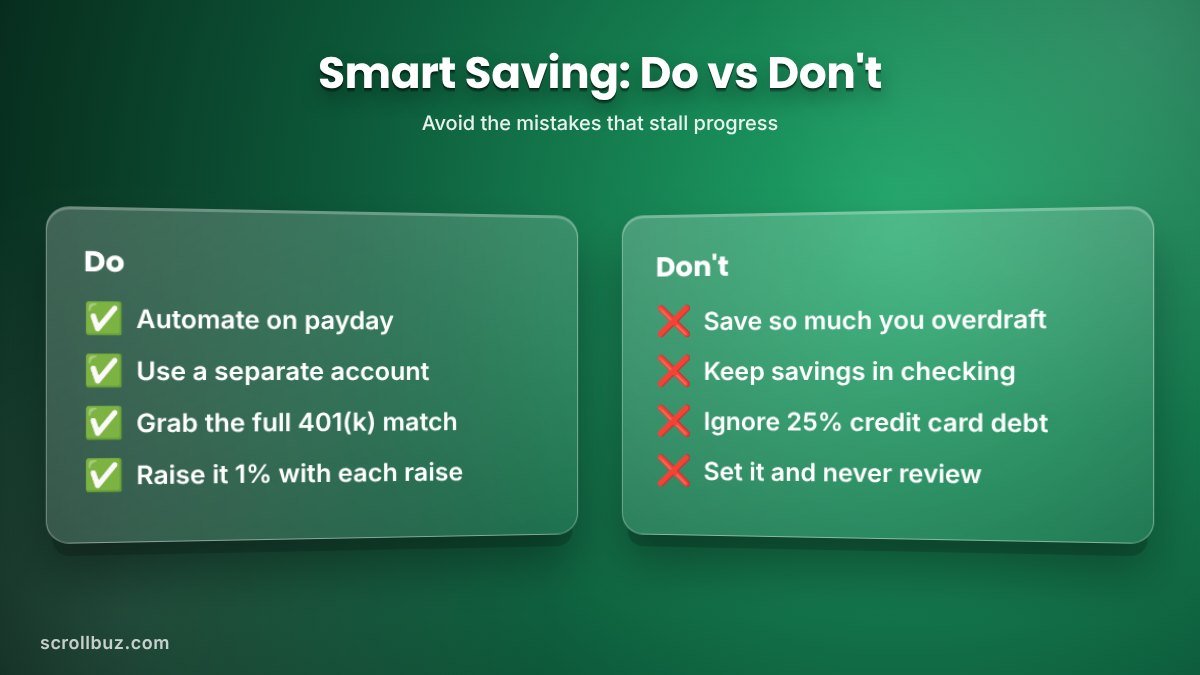
- Saving too much at first. If you overdraft, the fees wipe out your progress.
- Keeping savings in checking. It will get spent. Use a separate account.
- Ignoring high-interest debt. A card charging 25% interest grows faster than any savings account.
- Not adjusting. Review the amount every 3 to 6 months.
- Skipping the match. Free 401(k) money is the best return you’ll find.
Frequently Asked Questions
Is pay yourself first a good strategy?
Yes, for most people. It makes saving automatic and protects your goals from impulse spending. It works best when the amount is realistic for your bills.
Should I pay yourself first or pay off debt?
Do both. Build a small $1,000 emergency fund first, then send extra money to high-interest debt while keeping a small savings transfer going.
Does a 401(k) count when you pay yourself first?
Yes. Retirement contributions taken from your paycheck count. Many people use a 401(k) for retirement and a payday transfer for short-term goals.
What percentage should I pay yourself first?
Aim for 10% to 20% of take-home pay over time. Start lower if needed and increase it slowly.
Final Thoughts
You don’t need a perfect budget to build savings. You need one automatic transfer that happens before you can spend the money. Pick a small amount, set it for payday, and let pay yourself first do the hard work for you. In a year, you’ll be glad you did.