How Long Does a Car Battery Last? (Lifespan by Climate, Signs and Tips)
Your car starts fine every morning, until one cold day it doesn’t. If you’re wondering how long does a car battery last, the short answer is 3 to 5 years for a typical lead-acid battery. But that number hides a lot. A battery in Phoenix can die in under 3 years, while the same battery in Seattle might push past 6.
This guide explains what really controls battery life, how to read the date code on your own battery, the signs it’s getting weak, and simple habits that add months (sometimes years) to its life.
How Long Does a Car Battery Last on Average?
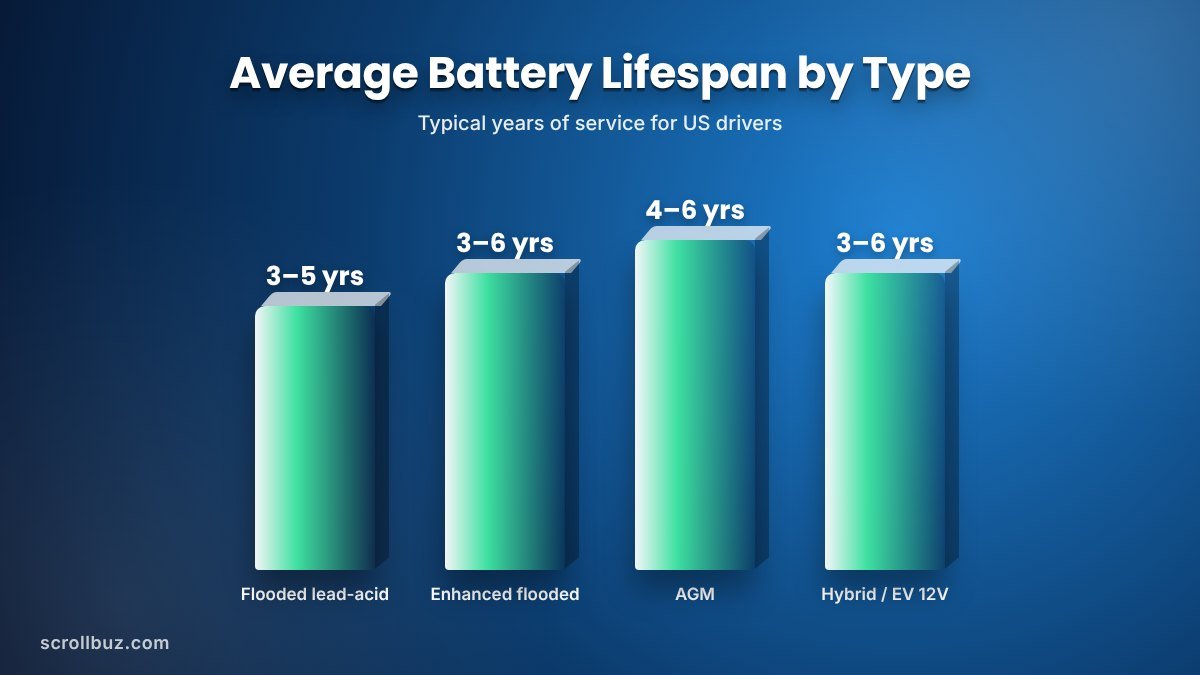
So, how long does a car battery last for most drivers? Most standard flooded batteries last 3 to 5 years. AGM (absorbent glass mat) batteries, found in many newer cars with start-stop systems, usually last 4 to 6 years. The 12-volt battery in a hybrid or electric vehicle often lasts 3 to 6 years, even though the big drive battery can last well over a decade.
So when people ask how long does a car battery last, the honest answer is “it depends on where you live and how you drive.” Here’s a quick overview:
| Battery type | Typical lifespan | Common in |
|---|---|---|
| Flooded lead-acid | 3 to 5 years | Older and budget cars |
| Enhanced flooded (EFB) | 3 to 6 years | Entry-level start-stop cars |
| AGM | 4 to 6 years | Start-stop, luxury and newer cars |
| 12V battery in hybrid or EV | 3 to 6 years | Hybrids and electric cars |
What Affects How Long a Car Battery Lasts?
Several everyday factors decide whether your battery hits year 2 or year 6.
Heat (the real battery killer)
Most people blame winter, but heat does the real damage. High under-hood temperatures speed up the chemical reactions inside the battery and cause fluid to evaporate and plates to corrode. Winter simply exposes the weakness that summer created, because a cold engine needs more power to crank.
Cold weather
Cold slows the chemistry inside the battery. At around 0°F, a battery can lose more than half of its available starting power, while the engine needs about twice as much power to turn over. That’s why a tired battery often fails on the first freezing morning.
Short trips
Starting the engine uses a big burst of energy. The alternator needs about 20 to 30 minutes of steady driving to put that energy back. If most of your drives are 5-minute trips, the battery slowly runs down and sulfates.
Parasitic drain
Dash cams, phone chargers, aftermarket alarms and a glovebox light that stays on can slowly drain the battery while the car is parked. A healthy car should draw less than about 50 milliamps when it’s off.
Vibration and loose mounts
A battery that isn’t clamped down tightly bounces around, which can damage the internal plates. Always check that the hold-down bracket is snug.
How Long Does a Car Battery Last by Climate?
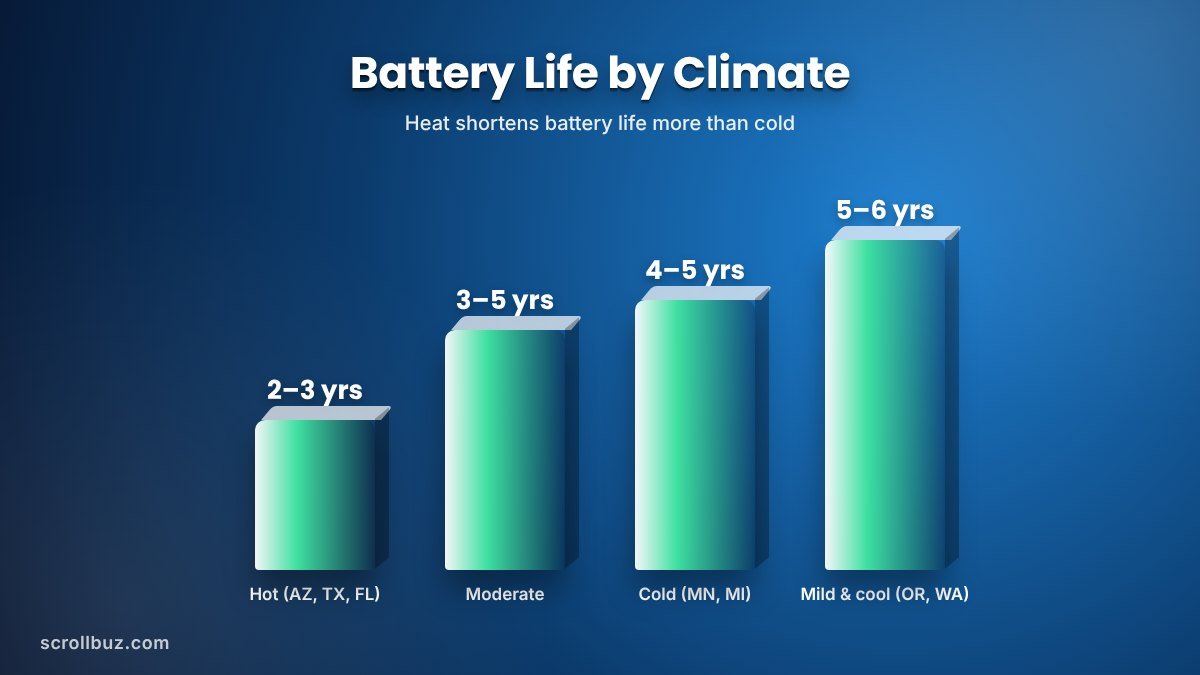
Location matters more than brand. If you want to know how long does a car battery last where you live, use this realistic guide for US drivers:
| Climate | Example states | Expected life |
|---|---|---|
| Hot | Arizona, Texas, Florida, Nevada | 2 to 3 years |
| Moderate | California coast, Virginia, Tennessee | 3 to 5 years |
| Cold | Minnesota, Michigan, Maine | 4 to 5 years |
| Mild and cool | Oregon, Washington | 5 to 6 years |
If you live in a hot state, plan on testing your battery every year after year two. Drivers in mild climates can usually wait until year three.
How to Check Your Car Battery’s Age
Before you guess how long does a car battery last in your car, find out how old it is. Most batteries have a date sticker or a code stamped on the case.
- Sticker format: A month and year, such as “11/24” for November 2024.
- Letter and number code: A letter for the month (A = January, B = February, and so on, often skipping “I”) and a number for the year. “K5” usually means October 2025.
- Store receipt: Your receipt or the store’s records will show the install date.
If the battery is older than 3 years and you’ve never tested it, get it tested before winter. Most auto parts stores test batteries for free.
Signs Your Car Battery Is Dying
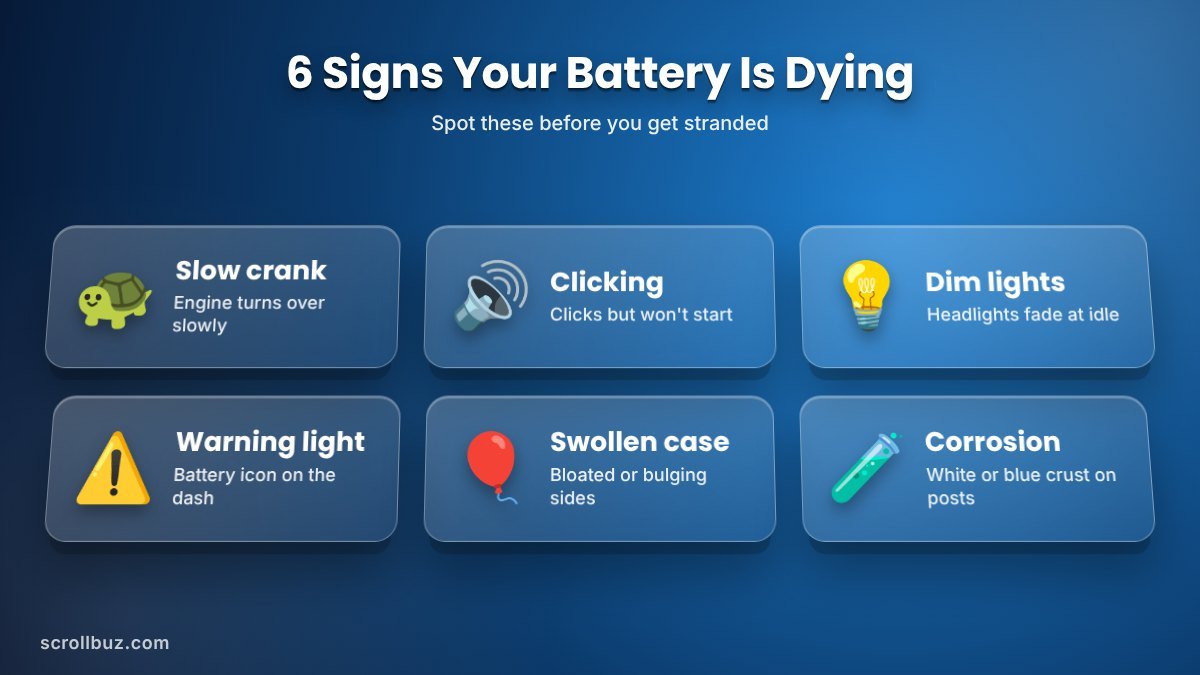
Batteries rarely die without warning. Even if you’re not sure how long does a car battery last in your model, these signs tell you it’s near the end:
- The engine cranks slowly, especially on cold mornings.
- You hear a clicking sound when you turn the key (read our guide on a clicking noise when trying to start your car).
- Headlights look dim at idle and brighten when you rev the engine.
- The battery warning light comes on (see battery light on in car).
- The case looks swollen or bloated.
- You see white or blue crusty corrosion on the terminals.
- You smell rotten eggs near the battery, which can mean it’s leaking.
- You’ve needed a jump start more than once in a month.
How to Test a Car Battery at Home
Age is only half the story. A quick test tells you how long does a car battery last from here, and a simple digital multimeter costs about $15 to $25.
- Turn off the engine and let the car sit for at least an hour.
- Set the multimeter to DC volts (20V range).
- Touch the red probe to the positive (+) terminal and the black probe to the negative (-) terminal.
- Read the voltage.
| Reading (engine off) | What it means |
|---|---|
| 12.6V or higher | Fully charged |
| 12.4V | About 75% charged |
| 12.2V | About 50% charged, needs charging |
| 12.0V or lower | Discharged or failing |
Then start the engine. With it running, you should see about 13.7 to 14.7 volts. A lower reading points to a charging problem, not just the battery. Keep in mind that voltage alone doesn’t show cranking strength, so a load test at a parts store is the best final check.
How to Make Your Car Battery Last Longer
You can’t control the weather, but you can control habits, and habits decide how long does a car battery last more than the price tag. These tips stretch battery life:
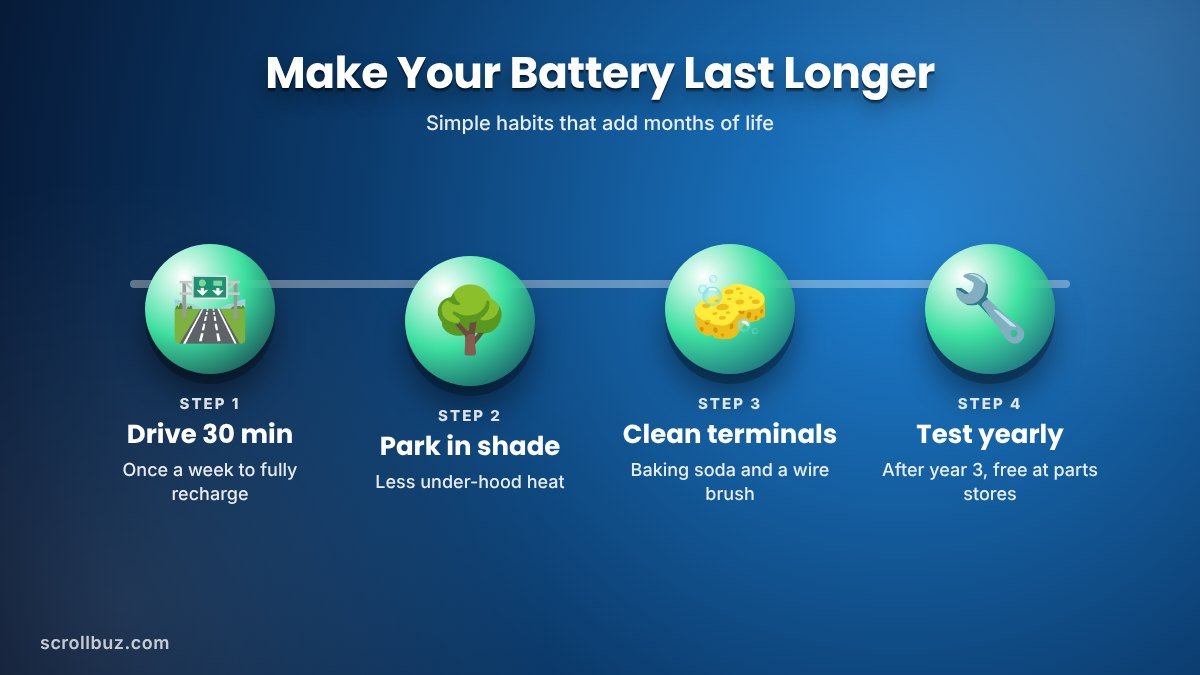
- Drive at least 30 minutes once a week to fully recharge the battery.
- Park in a garage or shade in summer to keep under-hood heat down.
- Clean the terminals with a baking soda and water paste and a wire brush.
- Tighten the hold-down clamp so the battery can’t vibrate.
- Unplug accessories like dash cams when parking for long periods.
- Use a battery maintainer (trickle charger) if the car sits for weeks.
- Turn off lights and electronics before shutting off the engine.
- Test it yearly once it passes the 3-year mark.
If you’re preparing for winter, pair these tips with our winter car emergency kit checklist and keep jumper cables or a portable jump starter in the trunk.
When Should You Replace Your Car Battery?
Replace the battery when a load test shows it’s weak, when it fails to hold a charge overnight, or when it’s 4 to 5 years old and you live somewhere hot. Don’t stretch it to see exactly how long does a car battery last in your car, because waiting for a full failure often means a tow, a missed appointment, or a jump start in a dark parking lot.
A new battery usually costs $100 to $250 for flooded types and $180 to $350 for AGM. Always replace an AGM battery with another AGM, because start-stop systems are designed around it. Many newer cars also need the battery “registered” with a scan tool so the charging system adjusts correctly.
Look for a battery with a fresh date code (less than 6 months old) and a free-replacement warranty of at least 2 to 3 years.
Frequently Asked Questions
How long does a car battery last if the car is not driven?
A healthy battery in a parked car usually lasts 2 to 4 weeks before it’s too weak to start the engine. Newer cars with more electronics can drain faster. A battery maintainer keeps it charged for months.
How long does a car battery last in a hybrid?
The small 12-volt battery in a hybrid typically lasts 3 to 6 years. It doesn’t start the engine the same way, but a weak one can still stop the car from powering on. Our hybrid car maintenance guide covers it in more detail.
How long does a car battery last in cold weather?
Cold doesn’t shorten life as much as heat does, but it exposes a weak battery fast. In cold states, most batteries last 4 to 5 years, yet a 3-year-old battery that’s already weak can fail on the first freezing night.
How long does a car battery last in hot weather?
In hot states like Arizona or Texas, expect about 2 to 3 years. Heat speeds up corrosion and fluid loss inside the case, so test yearly after year two.
How long does a car battery last with a dash cam?
A dash cam in parking mode can drain a battery in 1 to 3 days if it doesn’t have a low-voltage cutoff. Use a hardwire kit with a cutoff set around 12.0 to 12.2 volts.
How long does a car battery last after a jump start?
If the battery is healthy, it will recover after a 30-minute drive. If it dies again within a day or two, it likely needs replacing.
Can a car battery last 10 years?
It’s rare, but possible in a mild climate with regular long drives and a good AGM battery. Most drivers should not count on more than 6 years.
Does idling charge a car battery?
Idling charges it slowly. Driving at normal speeds charges it much faster because the alternator spins quicker.
Is it bad to jump-start a car often?
Yes. Repeated deep drains damage the battery’s plates. If you need jumps often, test the battery and the charging system.
Final Thoughts
So, how long does a car battery last? Plan on 3 to 5 years, less in hot states and a bit more in mild ones. Check the date code today, watch for slow cranking, and get a free test before winter. A few minutes of attention now can save you from being stuck on the coldest morning of the year.