

January has a way of showing up with a stack of statements. The gifts are unwrapped, the decorations are back in the box, and the credit card bills are bigger than you planned. If that sounds familiar, you are not alone, and it is very fixable when you have a clear plan.
This guide walks you through exactly how to pay off holiday debt step by step, with a real example, the math on interest, the best payoff methods and the traps to avoid. You will also learn how to make sure next Christmas does not land on a credit card at all.
Quick answer: To pay off holiday debt fast, list every balance and its interest rate, stop adding new charges, pick a payoff method (avalanche for the lowest interest or snowball for quick wins), set a fixed monthly payment above the minimum, and put any windfall such as a tax refund or bonus straight onto the balance. Most people can clear a typical holiday balance in 3 to 6 months with a firm plan.
What Counts as Holiday Debt?
Holiday debt is any balance you carry after the season because of Christmas spending. It is not just gifts. It usually includes:
- Credit card charges for gifts, food, decorations and parties
- Buy now, pay later (BNPL) installment plans from online checkouts
- Store cards opened for a one-time discount
- Travel costs such as flights, gas and hotels to see family
- Personal loans or overdrafts used to cover December bills
Buy now, pay later plans are the sneaky part. They feel small, but four or five of them can stack up to a large monthly bill, and they are easy to forget because they are split across different apps.
Why You Should Pay Off Holiday Debt Quickly
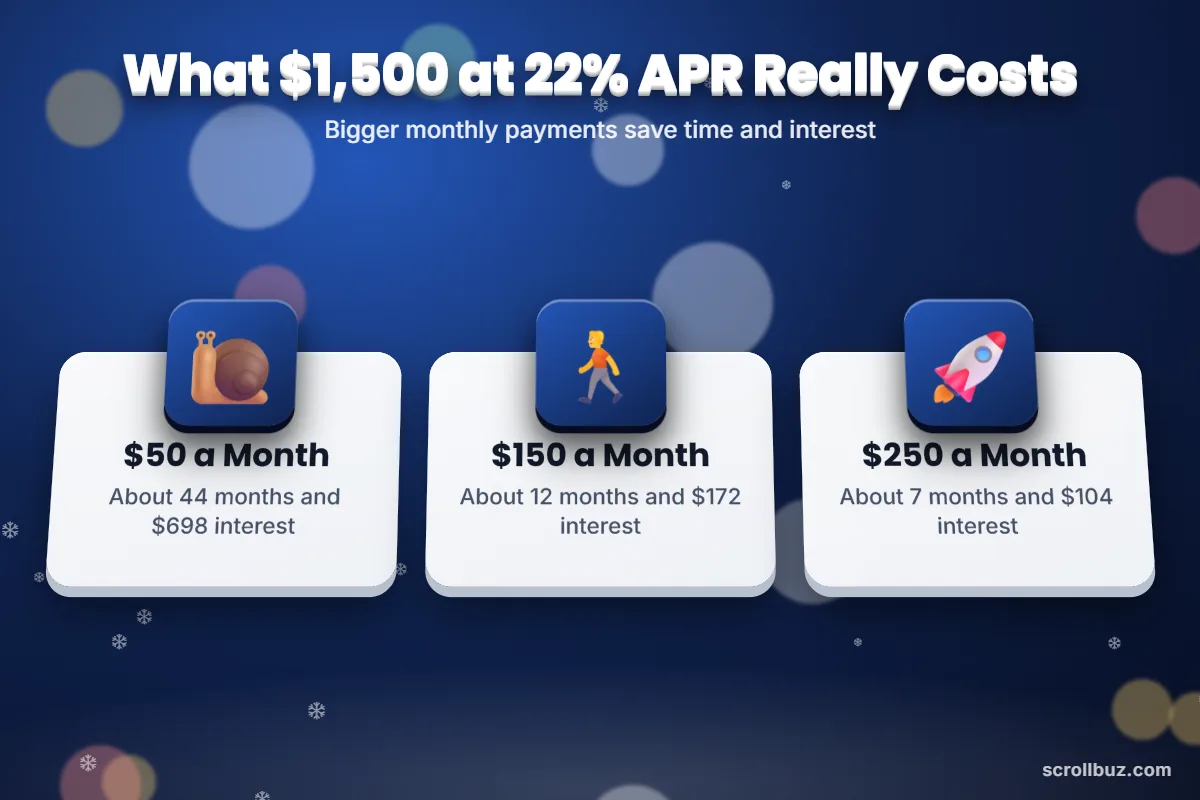
Credit card interest rates are often above 20% APR. That means your balance grows if you only make minimum payments. Here is what a $1,500 balance at 22% APR costs, depending on your monthly payment:
| Monthly Payment | Time to Pay Off | Total Interest Paid |
|---|---|---|
| $50 | About 44 months | About $698 |
| $150 | About 12 months | About $172 |
| $250 | About 7 months | About $104 |
Paying $250 a month instead of $50 saves almost $600 in interest and frees you more than three years sooner. High balances also raise your credit utilization, which can pull your score down. If you have already noticed a dip, see our guide on why your credit score dropped.
How to Pay Off Holiday Debt in 7 Steps
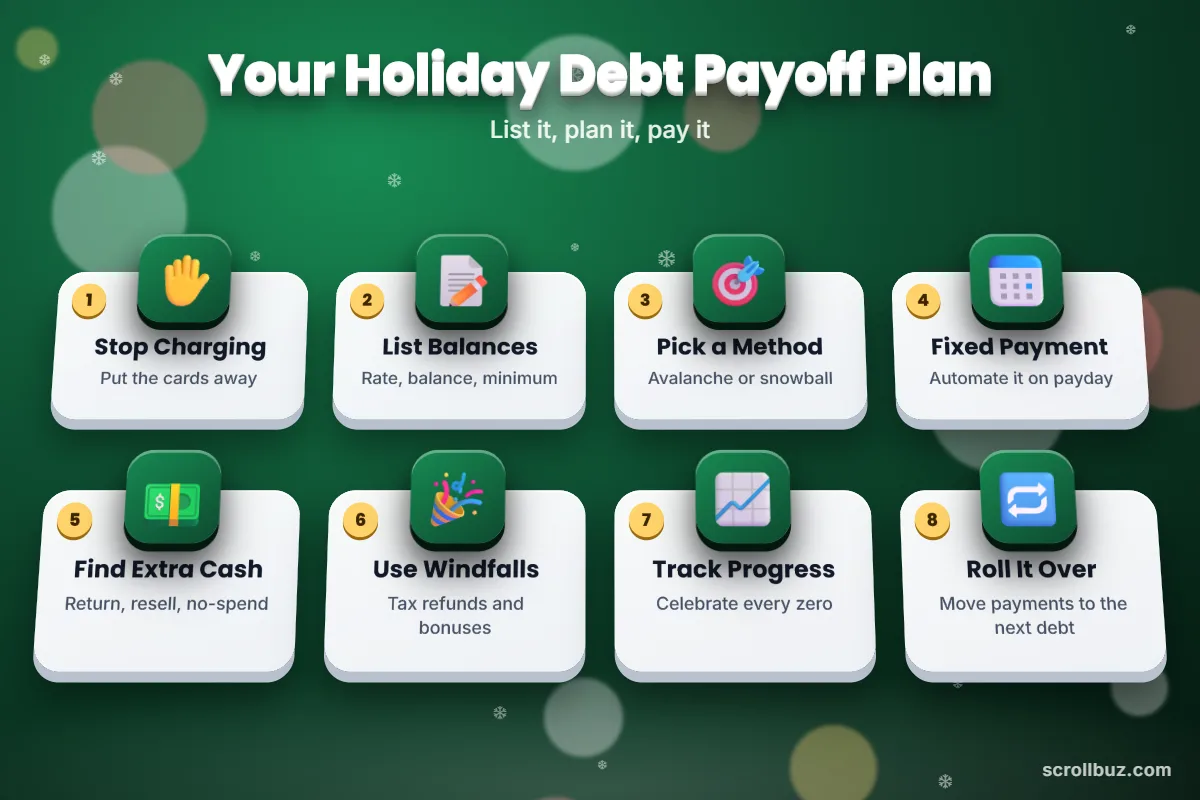
Step 1: Stop Adding to the Balance
Before anything else, stop using the cards that hold your holiday debt. Move them out of your wallet and remove them from saved payment methods on shopping sites. You cannot empty a bucket while the tap is still running.
Step 2: List Every Balance
Open each account and write down four things: the creditor, the balance, the interest rate and the minimum payment. Include every BNPL plan and its due dates. This list is your full picture, and most people are surprised by at least one line on it.
Step 3: Choose a Payoff Method
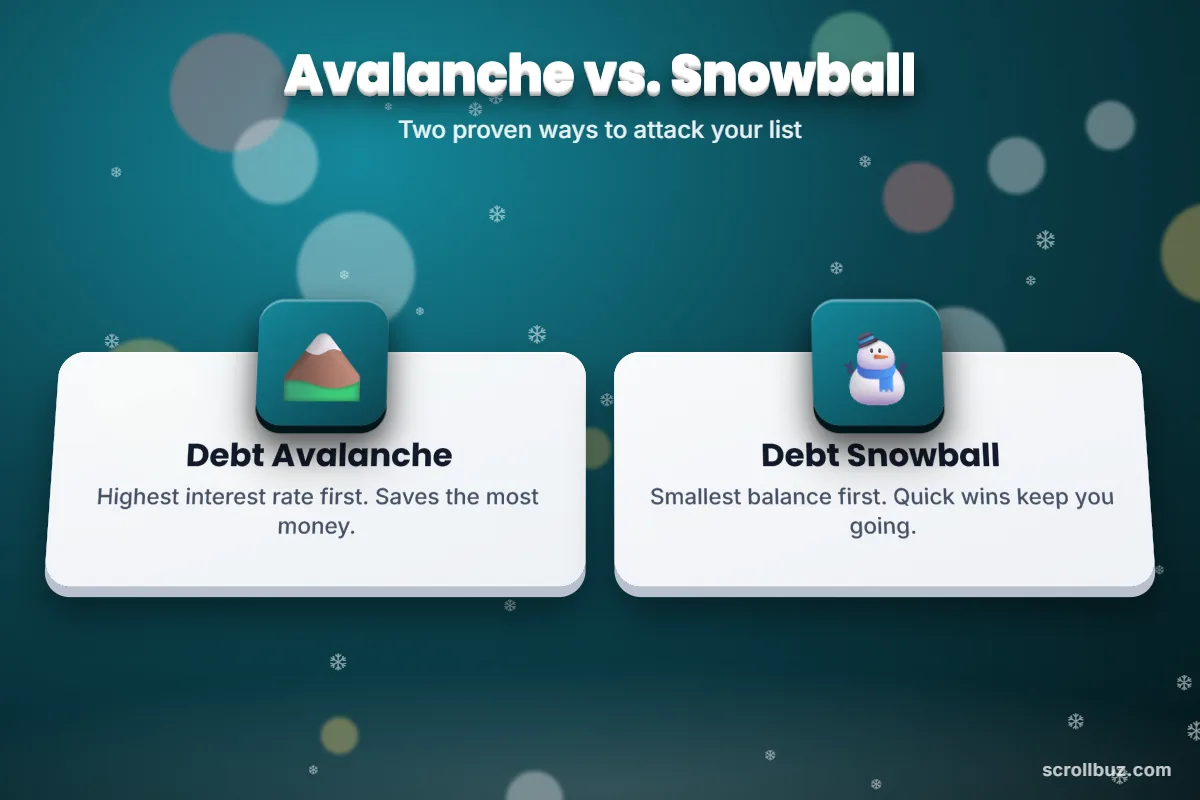
There are two proven ways to attack the list:
- Debt avalanche: Pay minimums on everything, then put every extra dollar on the highest interest rate first. This saves the most money.
- Debt snowball: Pay minimums on everything, then attack the smallest balance first. Quick wins keep you motivated.
If your balances are close in size, use the avalanche. If you have several small BNPL plans, the snowball can clear them in weeks and make your monthly budget feel lighter right away.
Step 4: Set a Fixed Monthly Payment
Decide on one monthly number you will put toward holiday debt and treat it like rent. A zero-based budget makes this easier because every dollar gets a job. Our guide to making a zero-based budget shows you how in six steps. Set up automatic payments on payday so the money leaves before you can spend it.
Step 5: Find Extra Cash Fast
A few extra dollars each week speed things up a lot. Try these:
- Return or resell unwanted gifts and put the cash on your card.
- Run a 30-day no-spend challenge in January.
- Cut your grocery bill with a simple meal plan and a list.
- Cancel streaming or app subscriptions you added for the holidays.
- Sell items you no longer use, such as old phones, games or clothes.
- Pick up a few short gig or overtime shifts for one month.
Step 6: Use Windfalls Wisely
Tax refunds, year-end bonuses and gift money are the fastest way to wipe out holiday debt. Commit to sending at least half of any windfall straight to your highest-priority balance. It is one of the few times a single decision can erase months of payments.
Step 7: Track Progress and Celebrate
Update your list every month and watch the totals drop. Color in a simple chart on the fridge. When one balance hits zero, celebrate with something free, then roll that payment into the next debt.
Should You Use a Balance Transfer or Loan?
Sometimes a tool can lower the interest on holiday debt so more of your payment goes to the balance. Here is how the main options compare.
| Option | How It Works | Watch Out For |
|---|---|---|
| 0% balance transfer card | Moves your balance to a new card with no interest for a set period, often 12 to 21 months | Transfer fee (often 3% to 5%), need good credit, rate jumps after the promo |
| Personal loan | One fixed payment and a fixed end date | Rates depend on credit; origination fees |
| Call your card issuer | Ask for a lower APR or a hardship plan | Not guaranteed, but it costs nothing to ask |
| Nonprofit credit counseling | A debt management plan with lower rates through an agency | Use only nonprofit agencies; check fees first |
A balance transfer only helps if you pay off the balance before the promo ends and you do not run the old card back up. Divide the balance by the number of promo months to find your monthly target.
A Real Example: Paying Off $2,400 in Holiday Debt
Maria finished December with $2,400 of holiday debt: $1,600 on a credit card at 24% APR, $500 on a store card at 29% APR and three BNPL plans totaling $300. Here is her plan:
- She paused both cards and deleted them from her phone.
- She used the snowball method on the BNPL plans and cleared them in six weeks.
- She switched to the avalanche and attacked the store card next, because of its 29% rate.
- She returned two gifts for $85 and sold an old tablet for $120.
- She put $600 from her tax refund on the credit card in March.
- She paid a fixed $400 per month on payday.
Maria was debt free by early May and paid only about $100 in total interest. The key was not a special trick. It was a list, a fixed number and steady action.
Mistakes That Keep You Stuck
- Paying only the minimum and hoping the balance shrinks.
- Missing BNPL due dates, which can mean late fees.
- Taking cash from a credit card, which usually has a higher rate and no grace period.
- Draining your entire emergency fund. Keep a small cushion so a car repair does not put you back on a card. Learn more in what an emergency fund is.
- Opening new store cards for discounts during the payoff period.
How to Avoid Holiday Debt Next Year
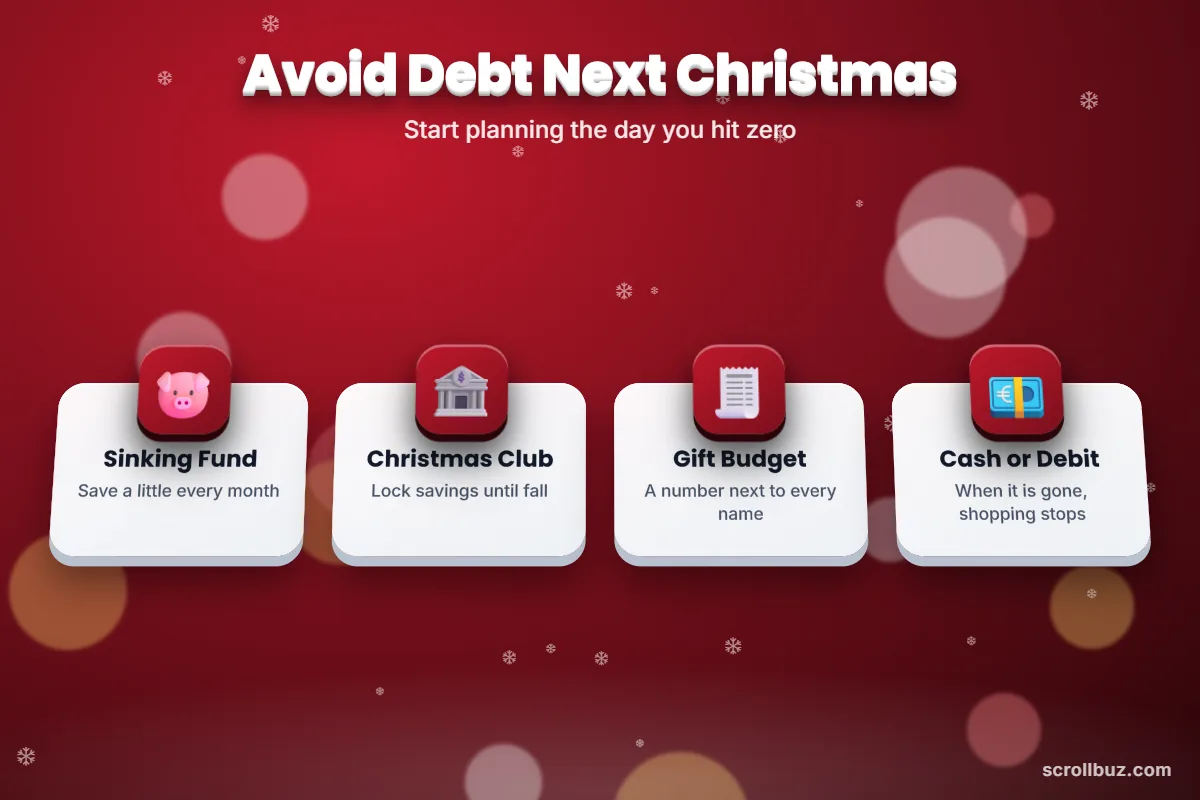
The best way to win is to never borrow for Christmas again. Once you are paid off, set up a plan for next December now:
- Start a sinking fund. Divide next year’s Christmas budget by 11 months and save that amount monthly. Our sinking fund guide explains how.
- Try a Christmas club account. Some banks lock money away until the fall. See how a Christmas club account works.
- Set a gift budget per person. Write the number next to each name before you shop. Our Christmas budget plan has a full example.
- Use cash or debit in December. When the money is gone, shopping stops.
- Agree on limits with family. A Secret Santa or gift exchange cuts costs for everyone.
Frequently Asked Questions
How long does it take to pay off holiday debt?
It depends on the balance and your payment. Many people clear holiday debt in three to six months by paying a fixed amount above the minimum and adding windfalls like tax refunds.
Is the avalanche or snowball method better?
The avalanche saves more money because it targets high interest first. The snowball can be better for motivation because small balances disappear quickly. The best method is the one you will stick with.
Does holiday debt hurt my credit score?
High balances raise your credit utilization, which can lower your score. As you pay balances down, your score usually recovers. Late payments do the most damage, so always pay at least the minimum on time.
Should I use my savings to pay off holiday debt?
Using extra savings can make sense because card interest is usually higher than savings interest. Still, keep a small emergency cushion so a surprise bill does not land back on a credit card.
Are buy now, pay later plans considered holiday debt?
Yes. BNPL plans are short-term debt with fixed payments. Add them to your list, track their due dates and pay them off as part of your plan.
Final Thoughts
Holiday debt feels heavy in January, but it does not have to follow you into spring. List what you owe, stop the new charges, choose a method and pay a fixed amount every month. Add windfalls, track your progress and set up a sinking fund for next year. With a clear plan, you can pay off holiday debt and enjoy next Christmas without the bills.
This article is for general education and is not personal financial advice. Consider talking with a qualified financial professional about your situation.