


Automotive batteries are generally associated with Hazard Class 8 or Hazard Class 9, depending on their chemistry and how they are presented for transportation.
A traditional wet lead-acid car battery is usually classified as Hazard Class 8: Corrosive Materials because it contains sulfuric acid. A lithium-ion automotive battery transported separately is generally classified as Hazard Class 9 Miscellaneous Dangerous Goods because it can present fire, overheating and thermal-instability risks.
The answer is therefore not the same for every vehicle battery. Correct classification depends on the battery’s chemical composition, construction, condition and shipping configuration.
Quick Answer
| Automotive battery type | Typical hazard class | Common UN number | Main transportation risk |
| Wet lead-acid battery | Class 8 | UN2794 | Corrosive acid leakage |
| Qualifying non-spillable lead-acid battery | Class 8 | UN2800 | Corrosive electrolyte |
| Lithium-ion battery shipped separately | Class 9 | UN3480 | Fire, short circuit and thermal runaway |
| Lithium-ion battery packed with or contained in equipment | Class 9 | UN3481 | Fire and electrical hazards |
| Battery installed in a complete vehicle or equipment | Class 9 vehicle entry may apply | UN3171 under current U.S. rules | Risks associated with battery-powered vehicles |
The current U.S. Department of Transportation Hazardous Materials Table lists wet acid-filled storage batteries as UN2794, Class 8, non-spillable wet batteries as UN2800, Class 8, lithium-ion batteries as UN3480 or UN3481, Class 9, and battery-powered vehicles or equipment as UN3171, Class 9.
What Is a Hazard Class?
A hazard class identifies the nature of the danger presented by a material during transportation. It does not simply rate an item as safe or dangerous.
Hazard classifications help regulators, carriers, warehouse operators and emergency responders understand whether a material presents risks such as:
- Corrosion
- Fire
- Toxic exposure
- Explosion
- Dangerous chemical reactions
- Environmental contamination
In the United States, the Department of Transportation regulates hazardous materials transported in commerce through the Hazardous Materials Regulations, often abbreviated as the HMR. These requirements are found in Title 49 of the Code of Federal Regulations and address matters such as classification, shipping descriptions, packaging, marking, labeling and transportation documents.
International shipments may also be subject to requirements developed for air and sea transportation, including the International Air Transport Association Dangerous Goods Regulations and the International Maritime Dangerous Goods Code.
Because the applicable rules can change according to the transportation method, a battery accepted for road transport may require different preparation before it can travel by air or sea.
Why Are Automotive Batteries Regulated as Hazardous Materials?
Automotive batteries store substantial energy and contain chemicals that can create hazards when a battery is damaged, improperly charged, short-circuited or incorrectly packaged.
The exact risk depends on the battery chemistry.
Risks associated with lead-acid batteries
A flooded lead-acid battery contains lead plates immersed in a liquid sulfuric acid electrolyte. If the battery casing cracks or the battery overturns, the electrolyte may escape and:
- Cause chemical burns
- Injure the eyes
- Damage clothing
- Corrode metal
- Contaminate surrounding cargo or surfaces
Charging a lead-acid battery may also produce hydrogen gas. Without sufficient ventilation, gas can accumulate and create a fire or explosion hazard near sparks, cigarettes or open flames. OSHA requires ventilation in relevant workplace battery-charging areas to disperse gases and reduce the possibility of an explosive mixture.
Risks associated with lithium-ion batteries
Lithium-ion batteries contain stored electrical energy and commonly use flammable electrolyte materials. Damage, overheating, manufacturing defects, overcharging or an internal short circuit can cause a cell to fail.
Heat from one failing cell may affect neighboring cells, creating a chain reaction known as thermal runaway. This event can release heat, smoke, flammable gases or fire. The severity of the risk depends on factors such as battery chemistry, design, size, state of charge and the extent of the damage.
These different chemical and physical risks explain why lead-acid and lithium-ion automotive batteries do not share one universal hazard classification.
Types of Automotive Batteries and Their Hazard Classes
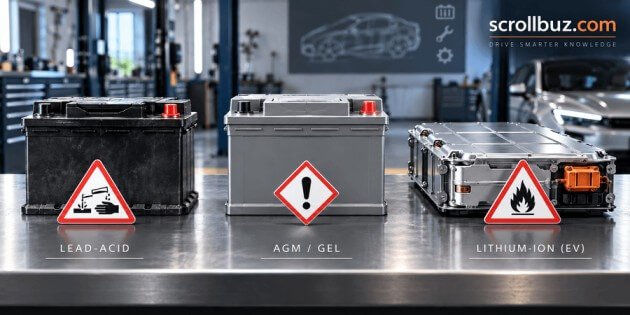
Flooded lead-acid batteries
Flooded lead-acid batteries are widely used as starting batteries in gasoline and diesel vehicles. Their internal components generally include:
- Lead plates
- Free-flowing sulfuric acid electrolyte
- A vented or semi-vented casing
- Positive and negative terminals
For transportation purposes, a wet battery filled with acid is generally assigned to Hazard Class 8 under the proper shipping description associated with UN2794.
The principal transportation concern is the corrosive electrolyte rather than the battery’s ability to generate electricity. U.S. regulations require wet batteries to be prepared in a way that prevents dangerous short circuits, damage and electrolyte leakage during normal transportation conditions.
AGM batteries
An Absorbent Glass Mat battery, usually shortened to AGM, is a lead-acid battery in which the electrolyte is held within fiberglass separators instead of moving freely around the battery case.
AGM batteries are commonly found in:
- Start-stop vehicles
- Luxury vehicles with high electrical demand
- Vehicles with regenerative systems
- Backup-power applications
- Recreational and specialty vehicles
Although an AGM battery is often described as sealed, that description does not automatically determine its transportation status.
A battery may use the UN2800 non-spillable battery entry when it meets the applicable construction, testing, packaging and marking conditions. Under U.S. rules, batteries qualifying for the non-spillable exception must be securely packed or secured against movement and must meet the prescribed resistance-to-leakage criteria.
Therefore, it is better to describe UN2800 as a possible classification for a qualifying non-spillable battery, not as an automatic classification for every AGM product.
Gel batteries
Gel batteries are another form of sealed lead-acid battery. Their sulfuric acid electrolyte is mixed with a substance such as silica to create a thick, gel-like material.
This construction reduces the movement of liquid inside the case, but the battery still contains a corrosive lead-acid electrolyte. Its exact transportation classification should be confirmed through:
- Manufacturer documentation
- Battery markings
- Test information
- Safety Data Sheet
- Shipping instructions
- Applicable non-spillable requirements
A gel design alone should not be treated as proof that every regulatory exception applies.
Lithium-ion automotive batteries
Lithium-ion batteries are used in electric vehicles, plug-in hybrids, conventional hybrids and an increasing number of advanced vehicle systems.
A lithium-ion automotive batteries may contain:
- Numerous individual cells
- Cell modules
- A battery-management system
- Cooling or thermal-management components
- High-voltage terminals
- Flammable electrolyte
- A protective enclosure
Lithium-ion batteries transported separately are generally assigned to Hazard Class 9.
The usual UN identification depends on the shipping configuration:
- UN3480: Lithium-ion batteries shipped by themselves
- UN3481: Lithium-ion batteries packed with equipment
- UN3481: Lithium-ion batteries contained in equipment
These entries appear as Class 9 materials in the current U.S. Hazardous Materials Table.
Why Lead-Acid Batteries Belong to Hazard Class 8
Hazard Class 8 covers corrosive materials. A corrosive material can damage living tissue or materially damage certain metals through chemical action.
For a wet lead-acid automotive battery, sulfuric acid is the main reason for the Class 8 classification. If released, the electrolyte may burn skin and eyes, attack metal surfaces and damage nearby packaging or cargo.
The classification does not mean a properly manufactured battery is continuously leaking or immediately dangerous during normal vehicle use. It communicates what could happen if the casing is compromised or the electrolyte is released during handling or transportation.
A cracked, leaking or badly damaged lead-acid battery requires more caution than an undamaged battery. It should not simply be placed in ordinary packaging and shipped as though it were intact.
Why Lithium-Ion Batteries Belong to Hazard Class 9
Hazard Class 9 is used for miscellaneous dangerous goods that present a transportation hazard but do not fit neatly within the definitions of the preceding hazard classes.
Lithium-ion batteries are placed in Class 9 because their transportation risks may involve several connected factors:
- High stored energy
- Internal short circuits
- Heat generation
- Flammable electrolyte
- Cell rupture
- Thermal runaway
- Fire propagation
- Accidental activation of connected equipment
Lithium-ion batteries are not primarily classified as Class 8 simply because some internal components may be chemically irritating. Their dominant transportation concerns are different from those of a wet lead-acid battery.
Battery Shipped Separately vs. Battery Installed in a Vehicle
A common classification mistake is assuming that every electric-vehicle battery should be described as UN3480 or UN3481.
Those numbers relate to lithium-ion batteries transported separately, packed with equipment or contained in equipment. A complete vehicle transported with its propulsion battery installed may fall under a vehicle-specific shipping entry instead.
Under the current U.S. Hazardous Materials Table, UN3171 covers a battery-powered vehicle or battery-powered equipment as a Class 9 entry. The regulations also require lithium batteries installed in vehicles or mechanical equipment to be securely fastened in their battery holders and protected against damage, short circuits and accidental activation, where applicable.
International systems may use different or newer vehicle-specific descriptions. For this reason, shippers should verify the rules that apply to:
- The country of origin
- The destination
- Road, air, rail or sea transport
- Whether the battery is installed
- Whether the battery is shipped separately
- The battery’s condition
- The carrier’s acceptance policies
The presence of an automotive lithium-ion battery does not, by itself, provide enough information to select the complete shipping description.
Common Automotive Battery UN Numbers
UN2794
UN2794 is commonly associated with:
Batteries, wet, filled with acid, electric storage
It is a Class 8 entry and is commonly relevant to traditional wet lead-acid automotive batteries.
UN2800
UN2800 applies to:
Batteries, wet, non-spillable, electric storage
It is also listed under Class 8. However, a battery must satisfy the applicable non-spillable conditions before a shipper relies on related exceptions.
UN3480
UN3480 applies to lithium-ion batteries transported on their own rather than installed in or packed with equipment.
It is a Class 9 entry.
UN3481
UN3481 applies to lithium-ion batteries:
- Packed with equipment, or
- Contained in equipment
It is also a Class 9 entry.
UN3171
UN3171 is the current U.S. entry for:
Battery-powered vehicle or battery-powered equipment
It is relevant when the battery is installed as part of a complete vehicle or qualifying piece of equipment rather than offered as a separate battery shipment.
Are AGM and Gel Batteries Always UN2800?
No. AGM and gel batteries should not automatically be declared as UN2800 merely because they are advertised as sealed, maintenance-free or spill-resistant.
The shipper must confirm whether the battery meets the applicable non-spillable criteria. Relevant evidence may include:
- Manufacturer test results
- Product specifications
- Transport classification statements
- Safety documentation
- Required external markings
- Battery condition
A damaged sealed battery may no longer be suitable for the same exception that could apply to an intact battery.
When reliable documentation is unavailable, obtain confirmation from the manufacturer, supplier, carrier or a qualified hazardous-materials professional before transportation.
What Is UN 38.3 Testing?
Lithium cells and batteries offered for transportation generally must be of a type that has passed the applicable tests in subsection 38.3 of the UN Manual of Tests and Criteria.
This group of tests evaluates how a cell or battery responds to transportation-related stresses. The testing program covers conditions such as:
- Altitude simulation
- Temperature variation
- Vibration
- Shock
- External short circuit
- Impact or crush
- Overcharge
- Forced discharge
U.S. lithium-battery regulations specifically require each lithium cell or battery to be of a type proven to meet the applicable UN 38.3 criteria.
Manufacturers and distributors may also need to make a UN 38.3 test summary available. A shipper handling an unfamiliar lithium automotive battery should request the relevant test and classification information instead of assuming compliance.
How to Identify the Correct Hazard Class
Use the following process before preparing an automotive battery for transport.
1. Identify the battery chemistry
Look for clear descriptions such as:
- Flooded lead-acid
- AGM
- Gel
- Lithium-ion
- Lithium metal
- Nickel-metal hydride
- Sodium-ion
Do not rely on appearance alone. Batteries with similar outer casings may contain different chemistries.
2. Determine the shipping configuration
Establish whether the battery is:
- Shipped by itself
- Packed alongside equipment
- Installed inside equipment
- Installed in a complete vehicle
- Shipped for recycling
- Damaged or defective
The shipping configuration can change the applicable UN number and requirements.
3. Inspect the battery’s condition
Check for:
- Cracks
- Leaks
- Swelling
- Heat
- Corroded terminals
- Impact damage
- Burn marks
- Exposed internal components
Damaged or defective batteries may require specialized packaging, approval or handling and may be rejected by ordinary carriers.
4. Review manufacturer information
Useful documentation may include:
- Safety Data Sheet
- Product data sheet
- Technical manual
- Shipping classification
- UN 38.3 test summary
- Watt-hour rating
- Non-spillable test statement
- Emergency-response information
5. Confirm the applicable regulation
Check the requirements for the transportation mode and jurisdiction.
Relevant authorities and frameworks may include:
- DOT
- PHMSA
- 49 CFR
- IATA Dangerous Goods Regulations
- ICAO Technical Instructions
- IMDG Code
- Carrier-specific hazardous-material policies
6. Verify the proper shipping description
The hazard class alone is not a complete shipping description. A compliant description may also depend on the correct:
- Proper shipping name
- UN identification number
- Hazard class
- Packaging instruction
- Marking
- Label
- Quantity limit
- Shipping paper entry
Is an SDS Required With Every Battery Shipment?
Not necessarily.
A Safety Data Sheet, or SDS, is an important source of chemical-hazard and handling information. It can help identify battery chemistry, workplace precautions, emergency measures and possible transportation classifications.
However, an SDS is not automatically the transportation document required for every battery shipment. Shipping-paper and declaration requirements depend on the material, quantity, transport mode, applicable exceptions and destination.
OSHA’s Hazard Communication requirements and DOT’s transportation requirements serve different purposes. Depending on how a battery is manufactured, handled and used in the workplace, an SDS may be required under workplace hazard-communication rules. That does not mean an SDS substitutes for any required hazardous-material shipping paper.
Packaging and Transportation Basics
Exact packaging requirements vary, but several principles appear repeatedly in battery-transport regulations.
Prevent short circuits
Battery terminals should be protected from contact with:
- Other terminals
- Metal tools
- Conductive packaging
- Loose components
- Nearby batteries
Terminal caps, non-conductive covers, suitable tape or individual protective packaging may be used when appropriate.
Prevent movement and physical damage
A battery should not shift freely inside a package or transport vehicle. It should be supported, restrained or cushioned according to the applicable packaging requirements.
For lithium batteries, PHMSA guidance commonly requires protection against short circuits and damage and, in many cases, a strong, rigid outer package or equivalent protection.
Control leakage
Wet lead-acid battery packaging may need to keep the battery upright and protect against electrolyte release.
Depending on the applicable provision, preparation may involve:
- Leak-resistant containment
- Absorbent material
- Secure closures
- Acid-resistant components
- Orientation markings
- Separation from incompatible materials
Use the correct marks and labels
A Class 8 battery and a Class 9 lithium battery do not use the same hazard communication.
Depending on the shipment, required communication may include:
- A Class 8 corrosive label
- A Class 9 lithium-battery label
- A lithium-battery mark
- UN identification numbers
- Orientation arrows
- Proper shipping names
- Additional handling information
Not every package requires every listed mark or label. Applicable exceptions, battery size, quantity, transport mode and shipping configuration must be considered.
Check the carrier’s rules
A shipment that meets a general regulatory provision may still be subject to an air carrier, courier or freight company’s acceptance policy.
Before offering a battery for transport, confirm that the selected carrier accepts:
- The battery chemistry
- The battery’s watt-hour rating
- The package size and weight
- The chosen transport mode
- Damaged or used batteries
- International destinations
Basic Safety Precautions for Handling Automotive Batteries
Classification rules mainly address transportation, but safe everyday handling is equally important.
Wear suitable protection
When handling a lead-acid battery, particularly one that is leaking or damaged, appropriate protection may include:
- Chemical-resistant gloves
- Safety goggles
- A face shield
- Protective clothing
- Acid-resistant footwear in workplace settings
OSHA battery-handling requirements address protective equipment, ventilation and facilities for flushing electrolyte exposure in relevant workplaces.
Provide ventilation during charging
Lead-acid battery charging can generate hydrogen gas. Charge batteries in an adequately ventilated area and keep ignition sources away.
Avoid:
- Smoking
- Welding
- Grinding
- Open flames
- Unprotected electrical sparks
Use suitable tools
Use properly maintained and insulated tools where the task calls for them. Do not allow a metal object to bridge the positive and negative terminals.
Follow the vehicle and battery manufacturer’s service instructions when disconnecting, removing, installing or charging a battery.
Do not handle a failing lithium-ion battery casually
Stop using or charging a lithium-ion battery that is:
- Swollen
- Smoking
- Hissing
- Leaking
- Unusually hot
- Giving off a strong odor
- Visibly damaged after a collision
Keep people away and follow the manufacturer’s emergency guidance. A high-voltage EV battery should be handled by trained personnel rather than treated like an ordinary removable starter battery.
How Should Used Automotive Batteries Be Disposed Of?
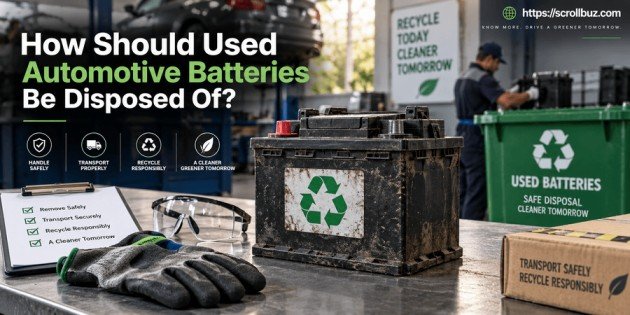
Used automotive batteries should generally be collected for proper recycling rather than placed in household trash.
The EPA recommends returning used lead-acid batteries to a battery retailer or an appropriate household hazardous-waste collection program. Lead-acid batteries should not be placed in normal trash or municipal recycling bins because they contain lead and sulfuric acid.
Used lithium-ion batteries also require controlled collection and recycling. Improperly discarded lithium-ion batteries may be damaged during waste handling and can cause fires in collection vehicles, recycling equipment or waste facilities.
For a large electric-vehicle battery, contact:
- The vehicle manufacturer
- An authorized dealership
- A qualified automotive recycler
- A licensed battery-recycling facility
- An insurer or recovery company after a collision
Do not dismantle, puncture or drain an EV battery pack without the required training and equipment.
Common Mistakes to Avoid
Assuming every automotive battery is Class 8
This overlooks lithium-ion batteries, which are generally Class 9 when transported as batteries.
Calling ordinary automotive batteries oxidizers
A conventional lead-acid vehicle battery is principally associated with the Class 8 corrosive hazard. It is not normally described as an oxidizer simply because chemical reactions occur inside it.
Treating every sealed battery as non-spillable
“Sealed,” “AGM” or “gel” does not automatically prove compliance with the UN2800 non-spillable conditions.
Using UN3480 for a complete electric vehicle
A complete vehicle with its propulsion battery installed may require a vehicle-specific entry rather than the UN number used for a battery transported by itself.
Confusing a UN number with a hazard class
A hazard class describes the type of danger. A UN number identifies a specific regulated material or shipping entry.
For example:
- Class 8 describes the corrosive hazard
- UN2794 identifies wet batteries filled with acid
- Class 9 describes a miscellaneous transportation hazard
- UN3480 identifies lithium-ion batteries shipped separately
Assuming an SDS is the only required document
An SDS provides safety information but does not automatically replace a hazardous-material shipping paper, shipper’s declaration or other transport document.
Frequently Asked Questions
Automotive batteries are an example of which hazard class?
Traditional wet lead-acid automotive batteries are generally Hazard Class 8. Lithium-ion automotive batteries transported separately are generally Hazard Class 9.
What hazard class is a standard car battery?
Most conventional gasoline and diesel vehicles use a lead-acid starter battery. A wet acid-filled version is generally Class 8 because it contains corrosive sulfuric acid.
Are automotive batteries Class 8 or Class 9?
They can be either. Lead-acid batteries are normally associated with Class 8, while lithium-ion batteries are normally associated with Class 9.
Are car batteries considered hazardous materials?
Yes, many automotive batteries are regulated as hazardous materials during transportation because they contain corrosive electrolytes, stored electrical energy or materials capable of contributing to fire and dangerous reactions.
What is the UN number for a lead-acid car battery?
UN2794 is commonly used for wet electric-storage batteries filled with acid. A battery that meets the applicable non-spillable conditions may use UN2800.
What is the UN number for a lithium-ion car battery?
UN3480 generally applies when a lithium-ion battery is shipped separately. UN3481 generally applies when it is packed with or contained in equipment.
Is an electric vehicle battery always UN3480?
No. UN3480 relates to a lithium-ion battery shipped by itself. A battery installed in a complete vehicle may fall under a vehicle-specific entry such as UN3171 under current U.S. rules.
Are AGM batteries Hazard Class 8?
AGM batteries are lead-acid batteries and the applicable table entries are associated with Class 8. Some may qualify as UN2800 non-spillable batteries, but that status should be supported by the required testing and documentation.
Do automotive batteries have a packing group?
The principal battery entries discussed in this article do not show a packing group in the U.S. Hazardous Materials Table. Requirements are instead controlled through their specific entries, special provisions and packaging sections.
Can a car battery be shipped through an ordinary parcel service?
Possibly, but only when the carrier accepts that battery type and all applicable classification, packaging, marking, labeling and documentation requirements are satisfied. Carrier restrictions can be stricter than the general regulatory minimum.
Can a damaged lithium battery be shipped normally?
No. A damaged or defective lithium battery may be subject to additional restrictions and specialized packaging. Contact the carrier and a qualified dangerous-goods professional before attempting shipment.
Can automotive batteries be placed in household trash?
Lead-acid and lithium-ion automotive batteries should not be placed in household trash. They should be returned to an appropriate retailer, dealer, collection program or qualified recycling facility.
Final Answer
Automotive batteries are an example of Hazard Class 8 when they are wet lead-acid batteries and Hazard Class 9 when they are lithium-ion batteries.
The most common traditional car starter battery contains corrosive sulfuric acid and is generally associated with UN2794, Class 8. A qualifying non-spillable lead-acid battery may use UN2800, which is also a Class 8 entry.
Lithium-ion batteries are generally Class 9. They may be identified as UN3480 when shipped separately or UN3481 when packed with or contained in equipment. When a propulsion battery remains installed in a complete vehicle, a vehicle-specific entry such as UN3171 may apply under current U.S. rules.
In the automotive industry, proper battery classification depends on more than just identifying it as a car battery. Check its chemistry, construction, condition, shipping configuration, manufacturer documentation and the regulations applicable to the transportation method.


Hi, this is a comment.
To get started with moderating, editing, and deleting comments, please visit the Comments screen in the dashboard.
Commenter avatars come from Gravatar.