
How to fix Christmas lights, unplug the strand, check the small fuses inside the plug and replace any that are blown, then look for loose, broken or missing bulbs in the section that’s out. Push each bulb firmly into its socket, swap any dark bulb with a working spare of the same voltage, and test again. A light tester tool can find the bad bulb in seconds if you can’t spot it.
Most of the time, a dead or half-dead strand comes down to one loose bulb or one blown fuse. This guide shows you how to find the problem fast, how fixing LED lights differs from incandescent lights, and when it’s time to replace the strand instead.
Why Christmas Lights Stop Working
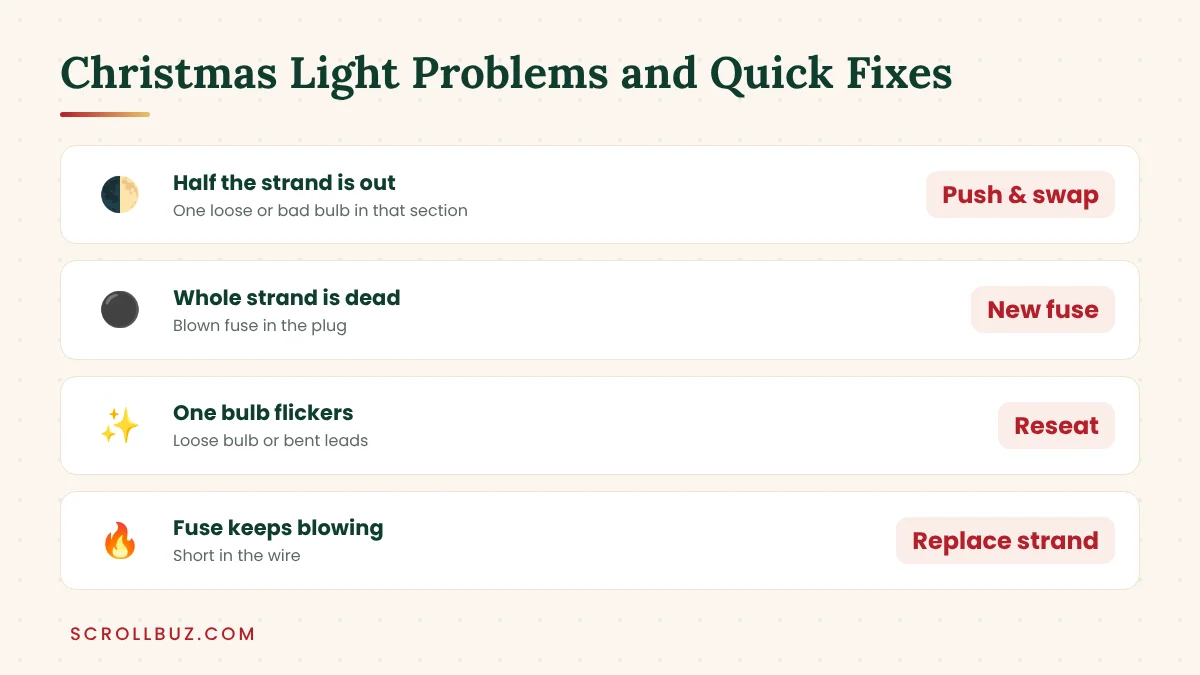
Mini light strands are wired in sections called series circuits. In a series circuit, electricity flows through each bulb one after another. If one bulb is loose or broken and electricity can’t pass, the whole section goes dark. That’s why half of a strand often goes out while the other half still works.
The most common causes are:
- A loose bulb that wiggled out of its socket during storage
- A broken or missing bulb
- A blown fuse in the plug
- A bulb with a failed shunt (a tiny wire that’s supposed to keep the circuit running when a filament burns out)
- Damaged wire from pets, staples or being crushed in storage
- Corroded sockets from outdoor moisture
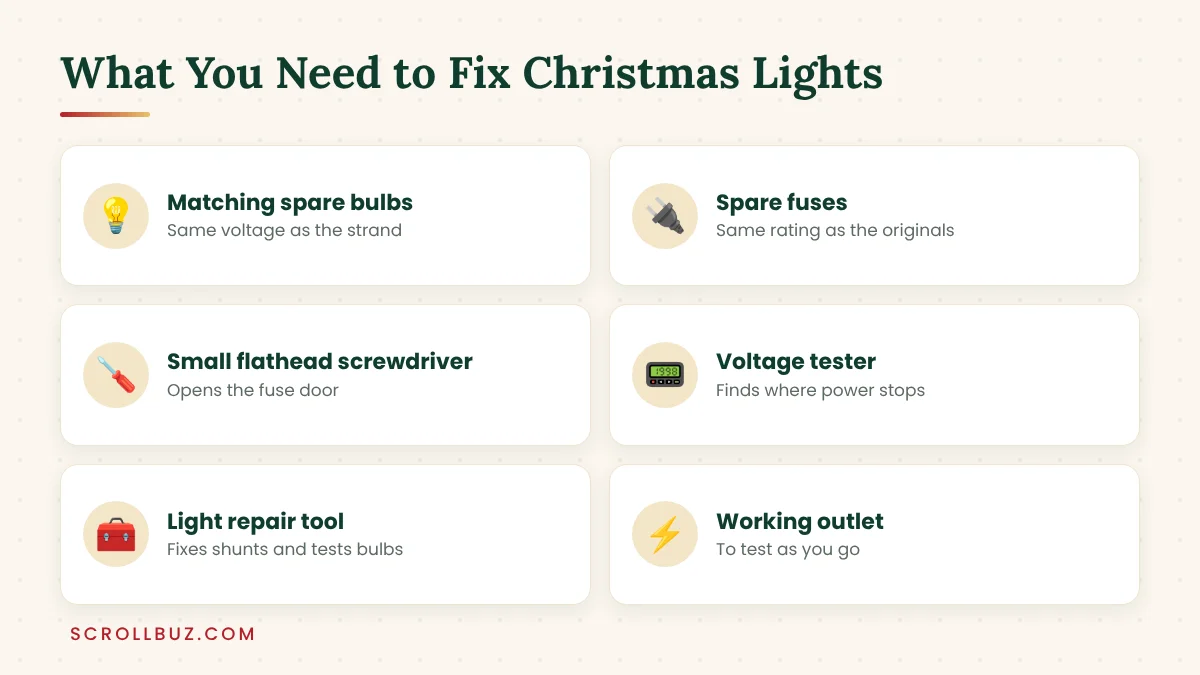
What You’ll Need
- Spare bulbs that match your strand (check the voltage on the box or tag)
- Spare fuses (usually included in a small bag with new lights)
- A small flathead screwdriver
- A light tester tool, such as a non-contact voltage tester or a Christmas light repair tool
- A working outlet
Fix 1: Check the Fuses in the Plug
If the whole strand is dead, start here.
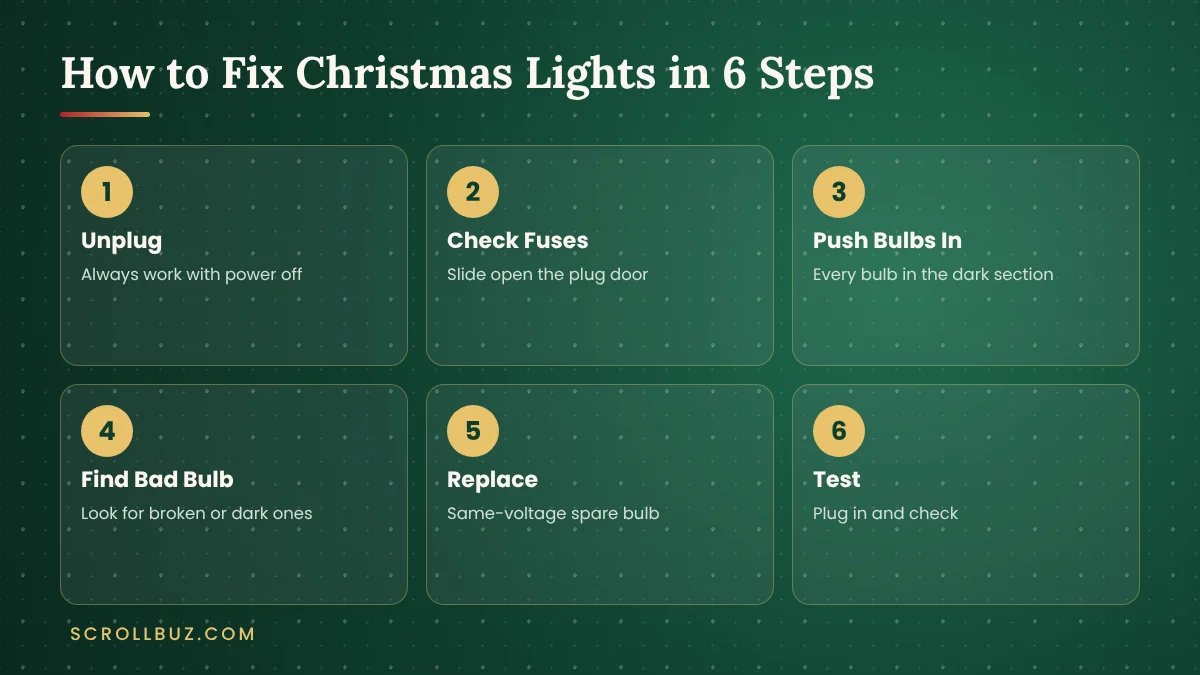
- Unplug the lights.
- Look for a small sliding door on the male plug (the end with prongs). It often has an arrow.
- Slide it open with a small flathead screwdriver.
- Remove the two tiny fuses. A blown fuse has a broken or blackened wire inside the glass.
- Replace blown fuses with new ones of the same rating.
- Close the door and test the lights.
Tip: If the new fuse blows again right away, there’s a short in the strand. Stop using it and replace the strand.
Fix 2: Push In Every Bulb in the Dark Section
This sounds too simple, but it fixes the problem more often than anything else.
- Unplug the strand.
- Starting at the first dark bulb, gently press each bulb firmly into its socket.
- Check that the two thin wires at the base of each bulb are straight and touching the socket contacts.
- Plug it back in and test.
Fix 3: Find and Replace the Bad Bulb
If pushing bulbs doesn’t work, you need to find the faulty one.
- Unplug the strand.
- Look for a bulb that’s broken, darkened, missing its filament or loose.
- Pull the bulb straight out of the socket along with its plastic base.
- Straighten the two wire leads on the replacement bulb and push it into the base.
- Push the base firmly back into the socket.
- Plug in and test.
Use the right bulb. Replacement bulbs must match the voltage of the strand. The wrong bulb can burn out quickly or make the other bulbs run hotter.
Fix 4: Use a Light Tester to Find the Problem Fast
When nothing looks broken, a tester saves a lot of time.
- Non-contact voltage tester: Plug in the strand and run the tester along the wire from the plug end. The tester beeps where there’s power. The spot where the beeping stops is near the bad bulb or socket.
- Christmas light repair tool: Some tools send a small pulse through the strand that can fix bad shunts, and also include a bulb tester and puller. These work on many incandescent mini lights.
Fix 5: Fix a Strand That’s Half Out
When exactly half (or one third) of a strand is out, one section has a break.
- Find the first dark bulb in the section, then work through that section only.
- Push in every bulb in the section.
- Swap bulbs one at a time with a known working bulb until the section lights up.
- Check the section for crushed or cut wire.
Fix 6: Fix One Flickering Bulb
A flickering bulb usually means a loose connection.
- Push the bulb firmly into the socket.
- Straighten the wire leads on the bulb base.
- Replace the bulb if it still flickers.
If the whole strand flickers, check the plug connection, try a different outlet and make sure you haven’t connected too many strands end to end.
Fix 7: How to Fix LED Christmas Lights
LED strands work a little differently.
- Many LED strands have bulbs that can’t be removed. If one LED fails, the section may stay dark, and the strand may not be repairable.
- Check the fuses first. LED strands often have fuses in the plug, just like incandescent strands.
- Look for a rectifier box (a small bump in the wire on some LED sets). If it’s damaged, the strand usually can’t be fixed at home.
- Replace removable LED bulbs only with LED bulbs made for that strand.
Because LED strands last longer and use less power, they’re usually worth buying again if one fails. See our guide on how to hang Christmas lights outside for tips on choosing LED vs incandescent.
LED vs Incandescent: Repair Differences
| Feature | Incandescent Mini Lights | LED Lights |
|---|---|---|
| Removable bulbs | Usually yes | Often no |
| Fuses in plug | Yes | Usually yes |
| Shunt repair tools work | Often | Rarely |
| Common failure | Loose or burnt bulb | Failed LED or rectifier |
| Worth repairing | Usually | Only if bulbs are removable |
When to Throw Away a Strand
Fixing lights is cheap, but safety comes first. Replace the strand if you see:
- Cracked, frayed or melted wire
- Exposed copper wire
- Fuses that keep blowing
- A plug that feels hot when in use
- Burn marks on sockets
Recycle old strands where possible. Many hardware stores and recycling centers accept them during the holidays.
How to Store Christmas Lights So They Work Next Year
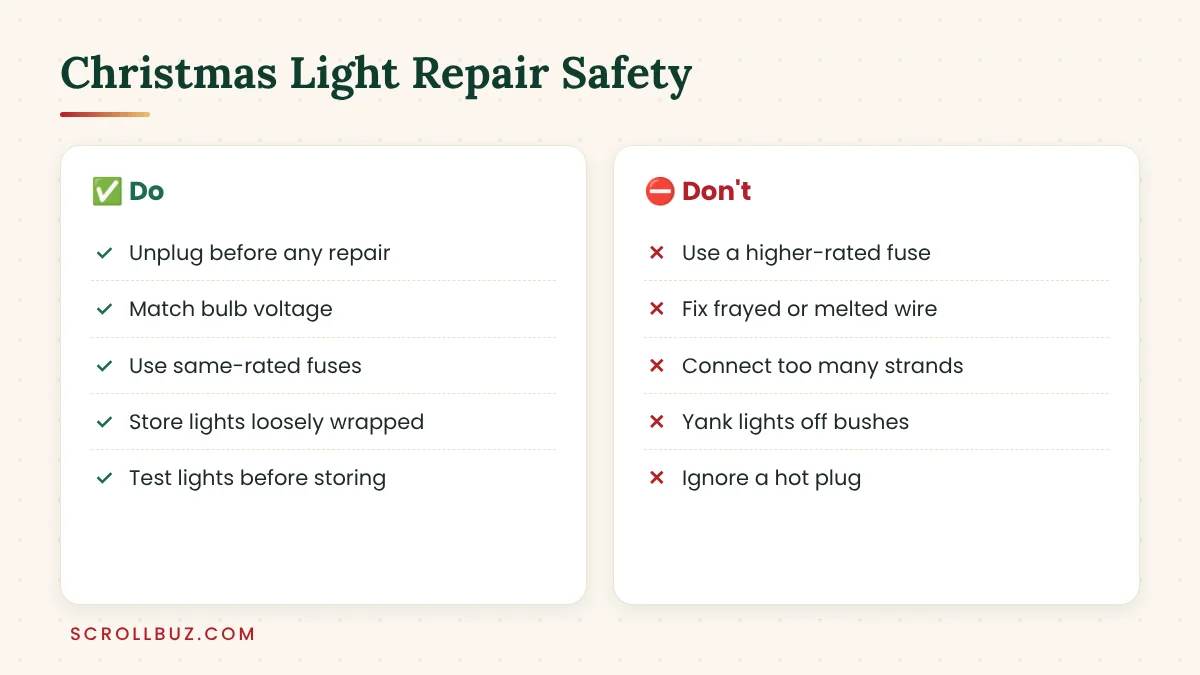
- Wrap lights loosely around a piece of cardboard, a cord reel or a hanger.
- Don’t pull strands off trees or bushes by yanking. That loosens bulbs.
- Store in a sealed bin in a cool, dry place away from pests.
- Keep spare bulbs and fuses in a labeled bag with each strand.
- Test lights before storing so you know which ones need fixing next year.
Safety Tips
- Always unplug lights before replacing bulbs or fuses.
- Never replace a fuse with a higher-rated fuse.
- Don’t connect more strands than the label allows.
- Use outdoor-rated lights outside and plug into a GFCI outlet.
Frequently Asked Questions
Why is half of my Christmas light strand out?
Mini lights are wired in sections. If one bulb in a section is loose, broken or missing, that whole section goes dark. Find and fix the bad bulb in the dark section.
How do I know if a Christmas light fuse is blown?
Open the sliding door on the plug and look at the tiny glass fuses. A blown fuse has a broken or blackened wire inside. Replace it with one of the same rating.
Can you fix LED Christmas lights?
Sometimes. Check the fuses first and replace removable bulbs if your strand has them. Many LED strands have sealed bulbs, so a failed LED may mean replacing the strand.
Why do my Christmas lights blow fuses?
Usually because there’s a short in the wire or too many strands are connected together. Check the label for the maximum connected strands and look for damaged wire.
Can I replace a bulb with any Christmas light bulb?
No. Use a bulb with the same voltage as the strand. The right voltage is usually printed on the box, the tag near the plug or the spare bulb bag.
Final Thoughts
Learning how to fix Christmas lights can save you money and a trip to the store. Start with the fuses, push in every bulb, then replace the bad bulb in the dark section. If a strand has damaged wire or keeps blowing fuses, replace it for safety. With good storage, your lights will be ready to go next year.