

A Christmas club account is a special savings account offered by many banks and credit unions that helps you save for holiday spending. You deposit money regularly throughout the year, usually with automatic transfers, and the bank pays out the full balance in the fall, typically in October or November, right before holiday shopping starts. Withdrawals before the payout date are often limited or come with a fee, which is the whole point: it keeps your Christmas money out of reach until you need it.
This guide explains how a Christmas club account works step by step, what fees and limits to check, how it compares to a high-yield savings account and a sinking fund, and how much to save each week.
How Does a Christmas Club Account Work?
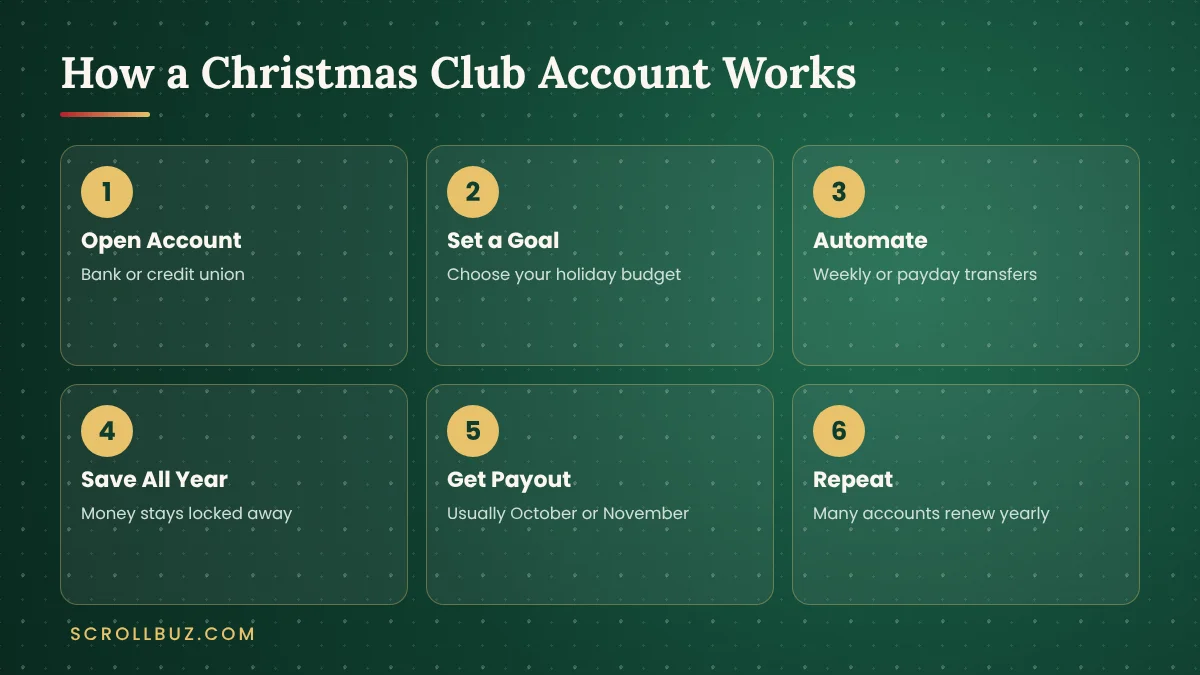
Most Christmas club accounts follow the same simple cycle:
- Open the account at a bank or credit union, often with a small or zero minimum deposit.
- Choose a savings goal and a deposit amount, such as $25 a week.
- Set up automatic transfers from your checking account or paycheck.
- Let the money grow through the year. Some accounts earn a little interest.
- Get your payout in the fall. The bank usually moves the balance to your checking account or mails a check.
- Start again. Many accounts restart automatically for the next year.
A Short History of Christmas Clubs
Christmas clubs date back to the early 1900s, when banks created them to help working families save small amounts every week for the holidays. Customers often carried a coupon book and made deposits in person. Today, the idea is the same, but the deposits are digital and automatic.
Pros of a Christmas Club Account
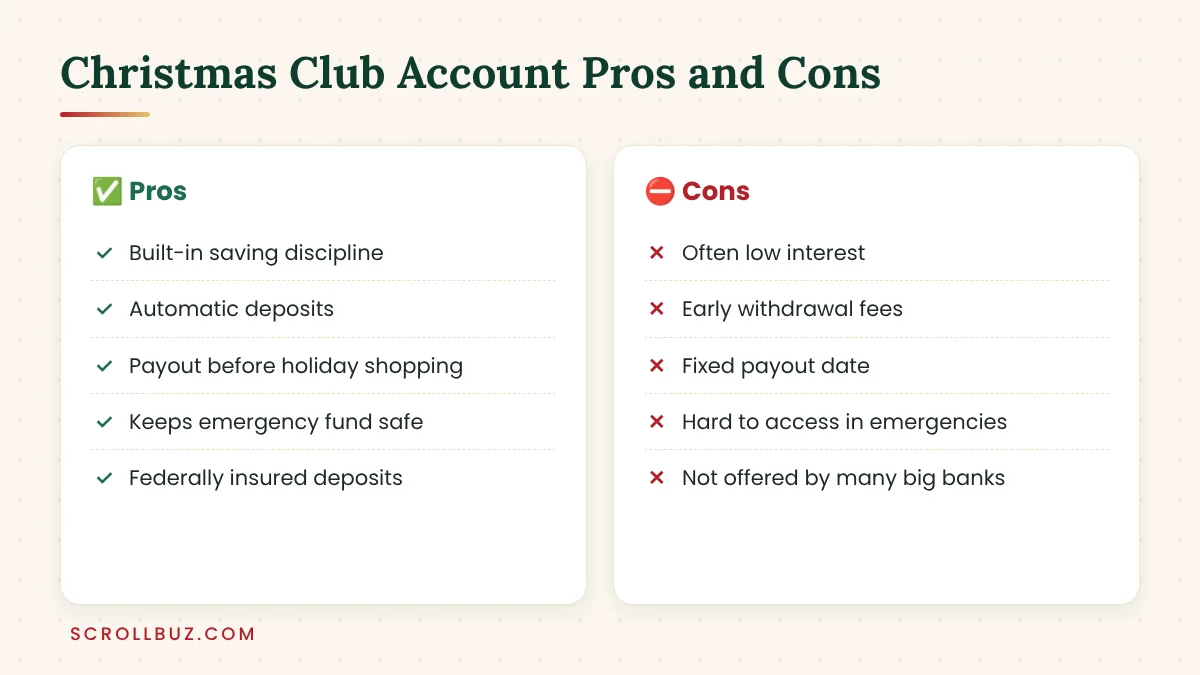
- Built-in discipline. Withdrawal limits stop you from spending holiday money early.
- Automatic saving. Small weekly transfers add up without much effort.
- Money arrives at the right time. The payout lands just before holiday shopping.
- Separate from everyday savings. Your emergency fund stays untouched.
- Insured deposits. Accounts at FDIC-insured banks or NCUA-insured credit unions are protected up to the standard limits.
- Less holiday debt. Paying with saved cash means fewer credit card balances in January.
Cons of a Christmas Club Account
- Low interest at many institutions. Some pay little or no interest compared to high-yield savings accounts.
- Early withdrawal penalties. Taking money out early may cost a fee or close the account.
- Fixed payout date. You can’t always choose when the money is released.
- Less flexibility. If you need the money in an emergency, it may be hard to access.
- Limited availability. Many large national banks don’t offer them. They’re more common at credit unions and community banks.
Christmas Club Account vs High-Yield Savings vs Sinking Fund
| Feature | Christmas Club | High-Yield Savings | Sinking Fund (DIY) |
|---|---|---|---|
| Interest | Often low | Usually higher | Depends on account used |
| Withdrawal limits | Strict until payout | Flexible | Flexible |
| Automatic payout | Yes, in the fall | No | No |
| Discipline built in | High | Low | Medium |
| Best for | People who spend saved money early | Savers who want the best rate | Budgeters with clear goals |
If you have strong self-control, a high-yield savings account usually earns more. If you know you’ll dip into the money, a Christmas club’s restrictions may be worth the lower rate. A middle option is a sinking fund, where you save for Christmas in a separate account or savings bucket with a clear goal.
How Much Should You Save in a Christmas Club?
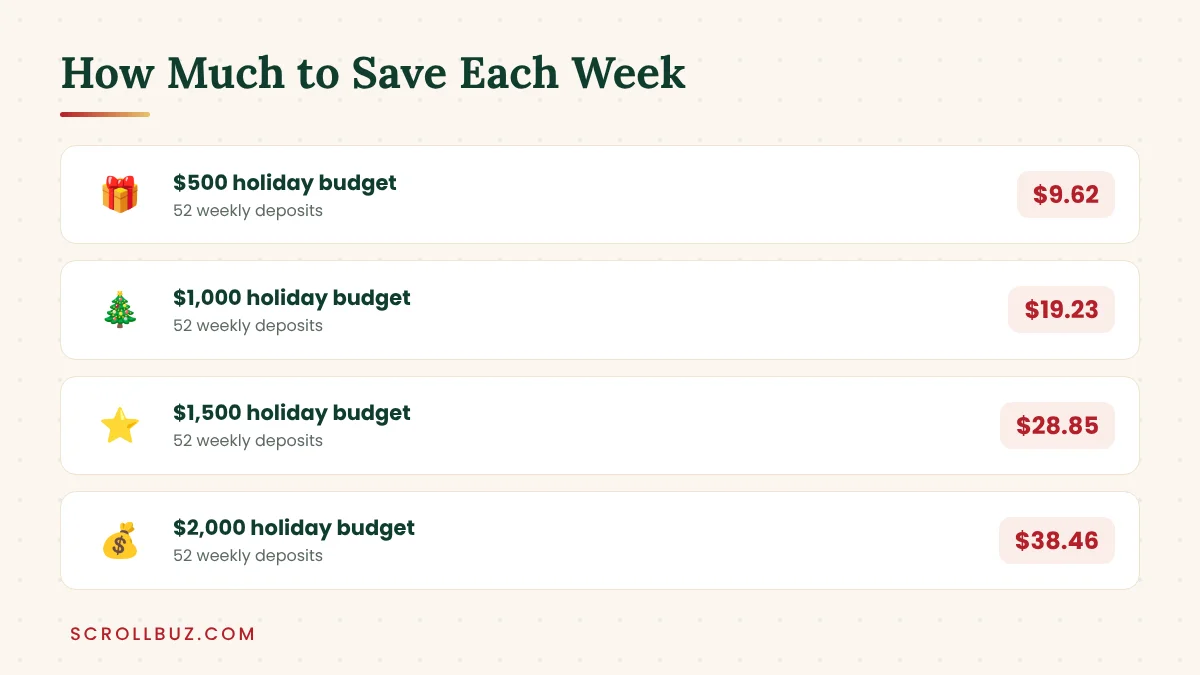
Start with your total holiday budget, then divide by the number of weeks or paychecks you have left.
| Holiday Budget | Weekly (52 weeks) | Bi-weekly (26 paychecks) | Monthly (12 months) |
|---|---|---|---|
| $500 | About $9.62 | About $19.23 | About $41.67 |
| $1,000 | About $19.23 | About $38.46 | About $83.33 |
| $1,500 | About $28.85 | About $57.69 | $125 |
| $2,000 | About $38.46 | About $76.92 | About $166.67 |
Not sure what your total should be? Our step-by-step guide on how to budget for Christmas helps you set a realistic number, including the hidden costs most people forget.
What to Check Before Opening a Christmas Club Account
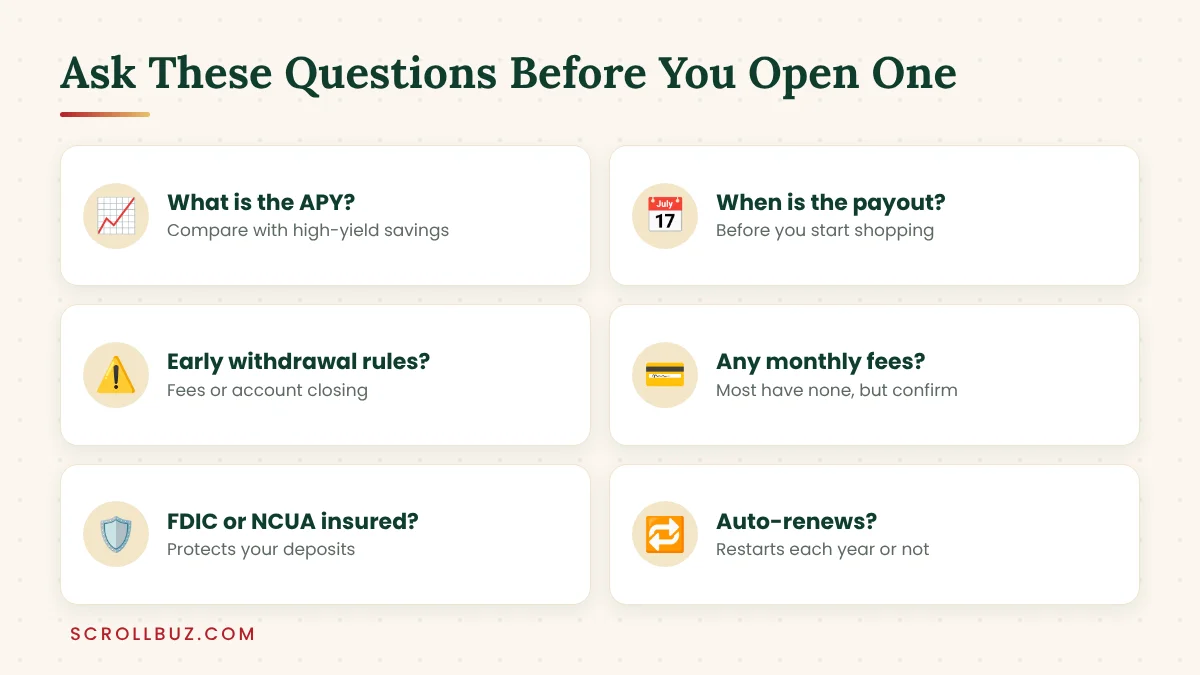
Account rules vary a lot between banks and credit unions. Before you open one, ask:
- What is the interest rate (APY)? Compare it to a high-yield savings account.
- When is the payout date? Make sure it comes before you start shopping.
- How is the payout made? Transfer to checking, a check or a deposit to savings.
- What happens if I withdraw early? Ask about fees and whether the account closes.
- Is there a minimum deposit or balance?
- Are there monthly fees? Most club accounts have none, but always confirm.
- Is the account federally insured (FDIC or NCUA)?
- Does it renew automatically each year?
How to Get the Most From a Christmas Club
- Start in January so weekly deposits stay small.
- Automate deposits on payday so the money moves before you can spend it.
- Round up your goal by 10% to cover surprises.
- Add windfalls. Put part of a tax refund or bonus into the account.
- Use the payout with a plan. Write your gift list and budget before the money arrives.
Are Christmas Club Payouts Taxable?
Your deposits aren’t taxed again because they’re your own money. But any interest you earn is usually taxable income. If you earn enough interest, your bank may send you a Form 1099-INT. This is general information, not tax advice, so check with a tax professional if you’re unsure.
Can You Still Open a Christmas Club Account Late in the Year?
Yes, but you’ll have less time to save. Some banks let you open a club account any time, with the payout the following fall. If it’s already October or November, a better short-term option is to save in a separate savings account and combine it with a few weeks of a no-spend challenge to free up cash for this year’s holidays.
Frequently Asked Questions
What is a Christmas club account?
It’s a savings account designed for holiday spending. You make regular deposits during the year, and the bank releases the money in the fall, usually in October or November.
Do Christmas club accounts earn interest?
Some do, some don’t. Rates vary by institution and are often lower than high-yield savings accounts, though some credit unions offer promotional rates.
Can I withdraw money from a Christmas club account early?
Usually only with limits. Many accounts charge a fee or close the account if you withdraw before the payout date. Check the rules before you open one.
Which banks offer Christmas club accounts?
They’re most common at credit unions and community banks. Many large national banks don’t offer them, but they may offer savings “buckets” or goal features that work in a similar way.
Is a Christmas club account worth it?
It’s worth it if you struggle to keep holiday savings untouched. If you’re a disciplined saver, a high-yield savings account may earn more while still keeping your money separate.
Final Thoughts
A Christmas club account is a simple way to save a little all year and have cash ready for the holidays. Its biggest strength is discipline, and its biggest weakness is often a low interest rate. Compare it with a high-yield savings account, pick the option that matches your habits, and start saving early. Next December, you’ll shop with cash instead of credit.